Fashion hit Mountain High Hospital like a torrential rain that drenched the patients, staff and community with showers of blessings. Like all experiences in uncharted waters, the fashion show had moments of uncertainty and worry but the purpose was to provide entertainment for patients for an hour or so, take their minds off their illnesses and highlight the Zulu beading teacher that had been our guest for the last two weeks. Even a bad, poorly attended fashion show would be better than none! The Zulu fashion show took a life of its own-a better description would be that the Community Grabbed the Diversion and turned it into a Big Event utilizing their ingenuity, expression and creativity. To kick off the Fashion Week, advertisements were posted around the valley and the hospital inviting everyone to come to the Mountain View Fashion Show and promised Zulu Fashions, Music and Refreshments.
All fashion shows must have a rehearsal so the day before the volunteer models gathered to learn how to walk, turn, and display their outfits. The rehearsal was a lot of fun as the Step, Step, Step, Turn, Smile, Turn were demonstrated. The AIDS Counselor was recruited as the announcer and she jumped into the roll with ease and grace. The list of models and outfits was prepared with a jaunty description of where the model might be heading in their special outfit. “Here is Sipho in his orange and green hand painted shirt headed for a night on the town in Newcastle. What a gorgeous guy.” The models included 6 patients, 3 nursing staff and one office worker. They giggled as they practiced their steps, turns and hand motions. The models were instructed to make sure they were gorgeous for the big show.
The morning of the fashion show tables were set up to display the handwork done by the patients and staff and post banners with turquoise birds announcing the show. No event in Zululand is complete without blasting rock music so by 1030am the hospital was rocking. Slowly the patients, residents of the valley and nursing staff began trickling into the chapel rocking in time to the music, many in traditional Zulu dress or other African garb. The trickle turned into a torrent as the chapel filled with people looking to have a good time. I quietly suggested to the announcer that she should turn down the music and signal the models to move to the rear for the show. Instead the rhythm of the event escalated and more people arrived boogying down the aisle (including officials from the church sponsoring the hospital.) After 30 minutes of this entry the announcer called the models to congregate to the rear where I expected the fashion show to begin. Instead the models lined up, the volume of the music cranked up and they each did their dance as they came down the aisle and paraded behind the pulpit in their fabulous Zulu outfits and blue hospital issues. The ten models each had their 15 seconds of fame; then, instead of quietly sitting down, they repeated the parade. The audience began cheering as the dance routines became more and more intricate and expressive. The announcer just smiled and enjoyed the spontaneous expression of art and creativity. After the models finally finished the hospital domestic employees in their pink uniforms went to the rear, made signals to each other and began prancing down the aisle dancing Zulu style with perfect foot rhyme, bumps, jerks and a big smile. The shy nursing students decided it was their turn and they gathered in the rear to practice their gig and come down the aisle in partners jiving to the music. Soon it was time for the head nurse, director’s wife and church official to do their stuff which was pretty good for management but did not match the domestics for enthusiasm and art. Individuals in Zulu dress began to steal the show but the highlight of the parade was the domestic in pink uniform coupled with a nurse in Zulu attire bumping as they swayed down the aisle.
After an hour of this amazing spontaneous expression of the joy for living, the music went down and Monki, the Zulu beading teacher, danced to the front and told her life story, speaking boldly about beauty and faith conquering despair and withdrawal. After her talk the floor opened up to individual artistic contributions as a chaplain trainee performed a dance about the great race of faith, two staff members sang solos (one was rendition of Rock of Ages using only the three words), a boys choir appeared from the school next door and sang Zulu melodies, church officials gave a blessing on the gathering and Monki was thanked for her extraordinary contribution.
The fashion show was held on a very warm day in KwaZuluNatal and after two hours of dancing and cheering the performers, the crowd was thirsty. As many things in Africa, the water supply dried up that morning and cups were nowhere to be found to make tea for that huge crowd. As spontaneous as the gathering occurred, money for purchasing canned soft drinks also appeared and the crowd finished their day of fashion with homemade biscuits, tarts, nobake cookies and drinks. It may have not met the standards of Strowbridge Junior High School, circa 1961, but the small attempt to entertain the patient population turned into a wonderful outpouring of local culture and articulated the need for celebrations and joy in this place. The residents know how to put on a show. They only need a forum. Big learning day for Peace Corps Volunteers!
Tuesday, January 30, 2007

Saturday, January 20, 2007

Royalty and Fashion Week at Mountain High

Brendon and I joined the Peace Corps to fulfill a lifetime dream, have some fun and maybe do some good!! Our remote location, 80 km to the nearest grocery store, seems an unlikely site for two middle-aged city people who love good restaurants and fine music. However, our dreams are fulfilled on a daily basis. This week topped the cake when a much loved Zulu princess came to visit the patient therapy sewing group and wanted to hear about our lives in the Peace Corps. She resides in Nongoma, the official headquarters for the Zulu Kingdom. The Zulu King traces directly back to Shaka, one of the history’s greatest strategists. The princess, however, won our hearts with her beauty and graciousness. She sat down on the wood bench with the patients in her lovely black gown and discussed Zulu culture. She did not announce her special status but walked in with a young boy and joined the group. Her bearing, clothing and impeccable English made me wonder who she was and how she found our sewing circle in the hospital chapel. She merely stated that she was from Nongoma. I, almost jokingly, asked if she was a princess and she said YES. I then charged back through my Peace Corps cultural training to find the proper response- Does one bow, curtsy, lower folded hands? Somehow the Peace Corps had overlooked this essential training in the cultural sessions and I drew a blank. The Princess saved the day by extending her hand for a western style handshake. She explained that she had business in the area and had been told about the women’s group and wanted to see the activities. By the way the Princess drives a silver KIA!
The Jabule therapy group this week was led by an African woman from Soweto who is an expert at Zulu beading and crafts. The director of the hospital had been praising this gifted woman since our arrival in Sept. and lo and behold she showed up Monday to teach the patients beading and sewing methods. In addition, she added exercises, group therapy, singing and dancing to the repertoire of the sewing circle; quitting time was kicked out to 4pm. The eight patients showed amazing stamina as they got the hang of the beading and picked up speed. On Monday she pulled out her wares-beaded necklaces, bracelets, dolls, aprons, purses, bags, white suede skirts, and traditional Zulu dance garb made out of impala skins. The first project tackled by the patients consisted of sewing a red glass bead border on a small cell phone bag. The beads form their own lace design as the needle is reinserted into a previously strung bead. The second project of the week was an elaborate six layer necklace that lies like a collar with colored bands of plastic bead extending to the shoulders. Some women were able to make two or three of these creations.
She told her life story that read like a tragedy; orphaned at four, mistreated by an uncle, hospitalized for 6 months with disc problems with four children to raise alone. Hers is also a life of faith with the church playing the stabilizing role in her life. This graceful woman also interwove art and creativity into every aspect of her life. On Friday she repeated her story to the patients in the Hospital’s AIDS Support Group who come together to try to find some meaning in their lives. Her T shirt and head scarf bore the telling message “Love Life”.
In conversation, it came up that the women would enjoy having a forum for their artistic endeavors to include all of the knitting/crochet and clothing they have hand sewn. Voila! Time for a fashion show. Thus the Mountain High Fashion Show will be held Thursday with patients and nurses modeling Zulu attire and jewelry, music, refreshments, boutique and a message about Beauty and Faith from our beading teacher Monki. This must be a first for a TB hospital in Africa! Of course most of the models will primarily be wearing hospital blue but it is a good background color for their creations. Hopefully, the parade of beauty will be able to make rounds through the hospital so that the bedridden patients can have a look at the Zulu art. They are bored with the sameness of the hospital bed 24 hours a day. This will be a busy week with the patients sewing and beading items for the boutique and practicing their fashion modeling. Step, step, step turn! Sure wish we had a makeup artist!
The Jabule therapy group this week was led by an African woman from Soweto who is an expert at Zulu beading and crafts. The director of the hospital had been praising this gifted woman since our arrival in Sept. and lo and behold she showed up Monday to teach the patients beading and sewing methods. In addition, she added exercises, group therapy, singing and dancing to the repertoire of the sewing circle; quitting time was kicked out to 4pm. The eight patients showed amazing stamina as they got the hang of the beading and picked up speed. On Monday she pulled out her wares-beaded necklaces, bracelets, dolls, aprons, purses, bags, white suede skirts, and traditional Zulu dance garb made out of impala skins. The first project tackled by the patients consisted of sewing a red glass bead border on a small cell phone bag. The beads form their own lace design as the needle is reinserted into a previously strung bead. The second project of the week was an elaborate six layer necklace that lies like a collar with colored bands of plastic bead extending to the shoulders. Some women were able to make two or three of these creations.
She told her life story that read like a tragedy; orphaned at four, mistreated by an uncle, hospitalized for 6 months with disc problems with four children to raise alone. Hers is also a life of faith with the church playing the stabilizing role in her life. This graceful woman also interwove art and creativity into every aspect of her life. On Friday she repeated her story to the patients in the Hospital’s AIDS Support Group who come together to try to find some meaning in their lives. Her T shirt and head scarf bore the telling message “Love Life”.
In conversation, it came up that the women would enjoy having a forum for their artistic endeavors to include all of the knitting/crochet and clothing they have hand sewn. Voila! Time for a fashion show. Thus the Mountain High Fashion Show will be held Thursday with patients and nurses modeling Zulu attire and jewelry, music, refreshments, boutique and a message about Beauty and Faith from our beading teacher Monki. This must be a first for a TB hospital in Africa! Of course most of the models will primarily be wearing hospital blue but it is a good background color for their creations. Hopefully, the parade of beauty will be able to make rounds through the hospital so that the bedridden patients can have a look at the Zulu art. They are bored with the sameness of the hospital bed 24 hours a day. This will be a busy week with the patients sewing and beading items for the boutique and practicing their fashion modeling. Step, step, step turn! Sure wish we had a makeup artist!
Saturday, January 13, 2007
Summer Back to School-Guns on Board
School starts next week in South Africa so the Mountain residents and town businesses are abuzz with parents anxiously buying school uniforms and supplies. The taxi to Vryheid filled up in a hurry at 6am today with shoppers getting their kids ready for school, just like September back to school at home. The children have been on summer vacation for two months with Christmas being a double whammy of holiday and freedom from school. The boarding students add a dynamic to the mountain top that we enjoy as they sing every night at 9 pm on their return to their dorms from study hall. They always have a cool greeting hanging around on the dirt road. The 60 boys in the boarding school are chaperoned by only one adult and have no soccer team or other activities to keep them busy. The Hospital had hoped that the Bond’s would organize a team and coach the boys but volunteering as a Ref for the AYSO league in Palos Verdes does not qualify one for coaching 17 year olds looking for blood. The kids here play soccer with a vengeance and are very skilled but need a coach to learn strategy. If anyone out there has a calling…..
The taxi ride started tamely enough, even though the mist of Mountain High enshrouded our home. One kilometer down the dirt road a small antelope (one of the small boks- reebok, springbok, bleesbok) sprang across the meadow. This was the first game that we have seen so close to home. Mr. Zulu, the driver got a big grin on his face and confidently pulled out a gun from the side of the car while driving through the mist. He then waved the gun at the antelope and we joked that it looked like a braai (barbeque) tonight. Fortunately he put the gun away and returned to driving the taxi down the mountain. We were almost incredulous seeing the ease that he produced the weapon while driving but safety issues in this Country probably require taxi drivers, bus drivers and truckers to be prepared to defend themselves and protect their cargos. There is an edge to South Africa that detracts from the enjoyment. The citizens are a strange combination of courtesy and kindness mixed with fear, suspicion and vigilance. We are constantly being warned not to picnic next to the roads, to hide our cash all over our bodies and carry a “dummy wallet” for muggers, stay inside at night, and avoid looking like a tourist. At the same time the locals are amazingly generous and trusting. A motel owner offered her car to us to drive to a local restaurant so that we wouldn’t have to walk at night. (we declined-Peace Corps does not allow driving when not on leave). When I thought I had missed the bus to Richards Bay because of delays at the beauty shop, the owner offered to drive me to the next stop to meet the bus. Eight Peace Corps members have been mugged out of our group of 80, but we have never even felt uncomfortable or endangered in any way. So it is hard to generalize but we are grateful we have two years to come to an understanding of South Africa.
Our front row seats in the taxi next to Mr. Zulu are a mixed blessing in spite of being more spacious (only 3 passengers can ride in the front row, the other rows are limited only by one’s imagination and aggressiveness). The middle front seat passenger is required to collect the taxi fare from all passengers and make change. The first step is to count the total number of passengers and multiply by the 22 Rand fare. This is the easy part. Then the money starts coming forward, change made for those R100 bills and the change passed back to the passengers. Mr. Zulu does not participate in this process-he is only interested in the final sun meeting his target. This process is full of room for errors and misunderstandings. The 50 cent coin looks like the 5 cent coin. Sometimes there is no change available and the passengers have to juggle around to make the fares come out right. The taxi does not deliver the passengers until the total is right-today 16 passengers (and 2 infants) = R352. I secretly hoped that we would be reassigned seats as the job requires too many skills for newcomers but today I looked around to the back of the taxi after all the change had been made and one woman announced that “Finished”, a good sign that no one was shortchanged. Today Mr. Zulu did not ask Brendon to fill out lotto numbers. I guess our luck is up or he got tired of losing the last four months with the Bond’s picks. Maybe our luck will come during the police traffic stops and his taxi is not put out of commission. Today the windshield wipers were working so we appreciate improvements, even in small doses. The government is trying to phase out the old unsafe taxis but there is resistance due to added costs for the owner.
The work at the Hospital was brightened this week by the arrival of 14 nursing students doing a monthly rotation in the TB wards. They live in rondavals on the hospital grounds without TV, cinemas, shopping, fast food or boyfriends. Their arrival brought an expansion of the Jabule Sewing group as they were solicited by some of the bedridden patients to obtain sewing and yarn materials from my stash to pass the hours in bed. Two of the nursing students asked for yarns and fabric to make hats for themselves. I felt badly turning them down but told them that membership in the elite Jabule group required a diagnosis of TB or AIDS. This week was also successful in getting a few men to sew booties and small coin bags out of python printed fabric purchased for R5 a meter ($.75). The interest in the coin bags started when the patient that finally received his welfare grant needed a place to put his money and conned a female patient into sewing a drawstring bag that he proudly wore around his neck containing his riches. Some of the other men wanted bags do so they were willing to sew for themselves in spite of their own stigma about men sewing. Wire and pliers were also offered for crafts but no takers this week. A chaplain student attempted to determine some meaningful activity for the men and discovered that they would enjoy learning how to repair shoes and carve wood so maybe these activities can be developed.
The good news is that the patient that received his welfare grant last week (with the python drawstring bag for bounty) was discharged on Wednesday and left the hospital to live with his children in a nearby town. He was feeling higher than a kite on Tuesday night when he started to imagine his new life outside of the hospital after being a patient for 1 ½ years and wearing dull blue pajamas 24 hours a day. He smiled broadly as he announced that maybe he would go to JoBurg and do some strong work. There are success stories at Mountain High!
The taxi ride started tamely enough, even though the mist of Mountain High enshrouded our home. One kilometer down the dirt road a small antelope (one of the small boks- reebok, springbok, bleesbok) sprang across the meadow. This was the first game that we have seen so close to home. Mr. Zulu, the driver got a big grin on his face and confidently pulled out a gun from the side of the car while driving through the mist. He then waved the gun at the antelope and we joked that it looked like a braai (barbeque) tonight. Fortunately he put the gun away and returned to driving the taxi down the mountain. We were almost incredulous seeing the ease that he produced the weapon while driving but safety issues in this Country probably require taxi drivers, bus drivers and truckers to be prepared to defend themselves and protect their cargos. There is an edge to South Africa that detracts from the enjoyment. The citizens are a strange combination of courtesy and kindness mixed with fear, suspicion and vigilance. We are constantly being warned not to picnic next to the roads, to hide our cash all over our bodies and carry a “dummy wallet” for muggers, stay inside at night, and avoid looking like a tourist. At the same time the locals are amazingly generous and trusting. A motel owner offered her car to us to drive to a local restaurant so that we wouldn’t have to walk at night. (we declined-Peace Corps does not allow driving when not on leave). When I thought I had missed the bus to Richards Bay because of delays at the beauty shop, the owner offered to drive me to the next stop to meet the bus. Eight Peace Corps members have been mugged out of our group of 80, but we have never even felt uncomfortable or endangered in any way. So it is hard to generalize but we are grateful we have two years to come to an understanding of South Africa.
Our front row seats in the taxi next to Mr. Zulu are a mixed blessing in spite of being more spacious (only 3 passengers can ride in the front row, the other rows are limited only by one’s imagination and aggressiveness). The middle front seat passenger is required to collect the taxi fare from all passengers and make change. The first step is to count the total number of passengers and multiply by the 22 Rand fare. This is the easy part. Then the money starts coming forward, change made for those R100 bills and the change passed back to the passengers. Mr. Zulu does not participate in this process-he is only interested in the final sun meeting his target. This process is full of room for errors and misunderstandings. The 50 cent coin looks like the 5 cent coin. Sometimes there is no change available and the passengers have to juggle around to make the fares come out right. The taxi does not deliver the passengers until the total is right-today 16 passengers (and 2 infants) = R352. I secretly hoped that we would be reassigned seats as the job requires too many skills for newcomers but today I looked around to the back of the taxi after all the change had been made and one woman announced that “Finished”, a good sign that no one was shortchanged. Today Mr. Zulu did not ask Brendon to fill out lotto numbers. I guess our luck is up or he got tired of losing the last four months with the Bond’s picks. Maybe our luck will come during the police traffic stops and his taxi is not put out of commission. Today the windshield wipers were working so we appreciate improvements, even in small doses. The government is trying to phase out the old unsafe taxis but there is resistance due to added costs for the owner.
The work at the Hospital was brightened this week by the arrival of 14 nursing students doing a monthly rotation in the TB wards. They live in rondavals on the hospital grounds without TV, cinemas, shopping, fast food or boyfriends. Their arrival brought an expansion of the Jabule Sewing group as they were solicited by some of the bedridden patients to obtain sewing and yarn materials from my stash to pass the hours in bed. Two of the nursing students asked for yarns and fabric to make hats for themselves. I felt badly turning them down but told them that membership in the elite Jabule group required a diagnosis of TB or AIDS. This week was also successful in getting a few men to sew booties and small coin bags out of python printed fabric purchased for R5 a meter ($.75). The interest in the coin bags started when the patient that finally received his welfare grant needed a place to put his money and conned a female patient into sewing a drawstring bag that he proudly wore around his neck containing his riches. Some of the other men wanted bags do so they were willing to sew for themselves in spite of their own stigma about men sewing. Wire and pliers were also offered for crafts but no takers this week. A chaplain student attempted to determine some meaningful activity for the men and discovered that they would enjoy learning how to repair shoes and carve wood so maybe these activities can be developed.
The good news is that the patient that received his welfare grant last week (with the python drawstring bag for bounty) was discharged on Wednesday and left the hospital to live with his children in a nearby town. He was feeling higher than a kite on Tuesday night when he started to imagine his new life outside of the hospital after being a patient for 1 ½ years and wearing dull blue pajamas 24 hours a day. He smiled broadly as he announced that maybe he would go to JoBurg and do some strong work. There are success stories at Mountain High!
Saturday, January 06, 2007
Got Your Goat! Fun in 2007
After our dream vacation touring the game parks and beaches of Kwa Zulu Natal, we journeyed back to our lives as Peace Corps Volunteers in a remote Christian hospital for TB and AIDS, high in the mountains of an indigenous forest. The Greyhound bus pulled into our town, we picked up groceries for the week and rode expectantly up the mountain road to home. In spite of the luxury living the last two weeks, we looked forward to sleeping in our own bed, cooking our own food, tending our garden and taking a shower after the long trip. Two of the four were not to be as a thin trickle of water slithered out of the faucet and then quit upon our arrival. The fan belt had broken on the water pump and a part had to be brought from town. “Let’s check the garden” I suggested to Brendon as I had some anxiety about leaving the beautiful mealy, cabbage and vegetable crops for two weeks. There was plenty of rain in the area during the interlude so all should be well.
The garden looked like it had been hit with a lawn mower! Most of the cabbage plants had been hacked from the inside out and the mealys were sawed off directly across the budding sheaves. What an ugly sight. In addition weeds had sprung up around the decimated cabbage plants. Immediately we suspected those large green and brown locusts that had been swarming around the hospital and declared our attempts at organic farming to be a dud. Bring on the herbicides, pesticides and any other cide that will sustain our feeble garden. The next day the hospital gardener reported that the culprit was a family of goats. The mother, wanting good nutrition for her children, moved in and helped herself to the budding cabbage heads and mealy leaves. The patients in the Jabule sewing group who lounge outside by the garden when then weather is nice stated that they tried to beat off the goats but they would not be deterred from eating the bounty. Usually goats are found in garbage heaps but they made their way into the hospital grounds. After our office duties the last two days, the second job was to try to salvage the remaining veges and strike terror into the hearts of any goat that came around. Truthfully, they are very cute and are quite a site with their unique coat patterns and kids trailing but I am glad I left my weapons with CA DHS.
Many of the patients were discharged over the Christmas holiday, but new patients are trickling in so my job is to encourage them to start a craft, sewing or needlework project and join the other women in conversation. They are reluctant to participate at first and ask what they will have to pay. There is no charge and they are given choices to select the project, style and colors that they prefer. This causes some delay and would be more efficient by assigning activities and materials but life in a TB hospital has very few opportunities for choice or creativity. The patients were thrilled with the beautiful yarns and materials that my son transported to SA from donors in California. The yarns here are very dull (and expensive) so the beautiful colors were a pleasure.
Friday brought success with the South Africa Welfare Department as I escorted a male patient to the bank and he was able to get his disability grant after a 1 ½ year wait and countless visits to the welfare office. We timidly went up to the teller and inquired as to whether the deposit had been made and Bingo, his grant was there for the taking. I had almost given up after an entire day was spent at the welfare office in Nov. and ended up with a quick escort out the door at 4 pm when they closed. The patient was jubilant and thrilled that at last he had a little cash in his pocket. I think of the patients being elderly as they move very slowly and seem aged. In fact most of them are under 40 and cannot fathom my age. (57 years) AIDS and TB have robbed them of their prime years, robustness and joy of living. Not to mention the dangers from the roads and accidents in this country. Everyone is in a hurry and the narrow two lane roads are full of obstacles-pedestrians, stalled cars, cows, goats and mist that obscure the dangers. A domestic employee of the hospital was killed in car accident this week when her car swerved to miss a stalled vehicle and she was thrown out. Life expectancy is very short (around 47 years) here in spite of the trappings of the first world. Many people are fatalistic about death and accidents-this may be a vestige of Apartheid where cause/effect and critical thinking were not encouraged. I am convinced that every human being is special and that there are no throwaway people. There are so many obstacles to prevention and safe practices-safe societies are a luxury to some degree. However, carnage from AIDS, TB, Malaria, wars and car accidents is decimating the parents and breadwinners of Africa. One more preventable death is a lament that underscores all the bodies that leave the hospital in cheap caskets. Life is not depressing in this place, only frustrating!
The garden looked like it had been hit with a lawn mower! Most of the cabbage plants had been hacked from the inside out and the mealys were sawed off directly across the budding sheaves. What an ugly sight. In addition weeds had sprung up around the decimated cabbage plants. Immediately we suspected those large green and brown locusts that had been swarming around the hospital and declared our attempts at organic farming to be a dud. Bring on the herbicides, pesticides and any other cide that will sustain our feeble garden. The next day the hospital gardener reported that the culprit was a family of goats. The mother, wanting good nutrition for her children, moved in and helped herself to the budding cabbage heads and mealy leaves. The patients in the Jabule sewing group who lounge outside by the garden when then weather is nice stated that they tried to beat off the goats but they would not be deterred from eating the bounty. Usually goats are found in garbage heaps but they made their way into the hospital grounds. After our office duties the last two days, the second job was to try to salvage the remaining veges and strike terror into the hearts of any goat that came around. Truthfully, they are very cute and are quite a site with their unique coat patterns and kids trailing but I am glad I left my weapons with CA DHS.
Many of the patients were discharged over the Christmas holiday, but new patients are trickling in so my job is to encourage them to start a craft, sewing or needlework project and join the other women in conversation. They are reluctant to participate at first and ask what they will have to pay. There is no charge and they are given choices to select the project, style and colors that they prefer. This causes some delay and would be more efficient by assigning activities and materials but life in a TB hospital has very few opportunities for choice or creativity. The patients were thrilled with the beautiful yarns and materials that my son transported to SA from donors in California. The yarns here are very dull (and expensive) so the beautiful colors were a pleasure.
Friday brought success with the South Africa Welfare Department as I escorted a male patient to the bank and he was able to get his disability grant after a 1 ½ year wait and countless visits to the welfare office. We timidly went up to the teller and inquired as to whether the deposit had been made and Bingo, his grant was there for the taking. I had almost given up after an entire day was spent at the welfare office in Nov. and ended up with a quick escort out the door at 4 pm when they closed. The patient was jubilant and thrilled that at last he had a little cash in his pocket. I think of the patients being elderly as they move very slowly and seem aged. In fact most of them are under 40 and cannot fathom my age. (57 years) AIDS and TB have robbed them of their prime years, robustness and joy of living. Not to mention the dangers from the roads and accidents in this country. Everyone is in a hurry and the narrow two lane roads are full of obstacles-pedestrians, stalled cars, cows, goats and mist that obscure the dangers. A domestic employee of the hospital was killed in car accident this week when her car swerved to miss a stalled vehicle and she was thrown out. Life expectancy is very short (around 47 years) here in spite of the trappings of the first world. Many people are fatalistic about death and accidents-this may be a vestige of Apartheid where cause/effect and critical thinking were not encouraged. I am convinced that every human being is special and that there are no throwaway people. There are so many obstacles to prevention and safe practices-safe societies are a luxury to some degree. However, carnage from AIDS, TB, Malaria, wars and car accidents is decimating the parents and breadwinners of Africa. One more preventable death is a lament that underscores all the bodies that leave the hospital in cheap caskets. Life is not depressing in this place, only frustrating!
Wednesday, January 03, 2007
Picture Gallery


For more pictures click here , open the albums by clicking the album cover picture, get larger images by clicking on pictures in albums.
Saturday, December 30, 2006
Game Spotting for New Year's
Enjoy New Year's! Peace in 2007!
We hit the road this week and were so excited to see some of South Africa, touring our province KwaZuluNatal AKA Zululand. After a week of fabulous game parks, pristine beaches, great resorts, Indiana Jones scenery, and family fun we are convinced that the Peace Corps is one of life’s greatest adventure and a whole lot of fun. We started our journey by taking a Greyhound bus ride to Richard’s Bay, 2 hours north of Durban and renting a car. Although we then had to backtrack to pick up our son in Joburg, it was nearly impossible to rent a car closer to home and the connections to JoBurg would ave put us in a dangerous place at 10pm at night. (many decisions in South Africa are made on the basis of safety) Our initial thought was to rent a four wheel drive vehicle to tackle the rough roads in the game parks, but the costs proved prohibitive and so we ventured forth in a Hyundai Sonata sedan. Richard’s Bay is a new city that was formerly just a bait station for St. Lucia National Seashore and Game Preserve. Today it is an industrial city with monkeys in the nature preserves, subdivisions without walls or electrified fences and a shopping mall at the heart of the city. Very first world!! The hotel garden looked just like Hawaii with thatched roofs, hibiscus, palms, pool, and ferns.
Our first stop after JoBurg was four nights at a beach house on Zinkwazi Beach for family Christmas and beach R and R. Turkey and ham dinner with dressing and cranberry sauce plus monkeys, hawks, and weaverbirds in the backyard for entertainment. Durban is famous for mouthwatering curries where mild means hot hot hot so we did not hesitate to try any curry offered. Our older son arrived on Christmas day to sunny tropical weather; we were glad we didn’t have to apologize for the thunderstorms that have been constant the last two months.
On to Zululand game resorts hoping that they would not disappoint. In fact, we toured four game preserves in four days and found three of the Big Five (elephants, rhinos, cape buffalo) plus numerous giraffes, zebras, impalas, tesserbes, nyala, wart hog, bush pig, wildebeest at close range. The graceful impalas joyfully chased each other with an elegance found in pretty pubescent ballet dancers and contrasted with the awkward gawky wildebeest that hump along rather than prance. Baby giraffes were spotted munching on thornbark trees supervised by their vigilant mothers. A quick visit to Umfolozi Park on the way to Durban airport yielded a rhino within 20 feet of the road causing one to quickly roll up the windows and stare in amazement at this prehistoric creature. Game spotting in the preserves is great sport and a good excuse to enjoy the amazing scenery consisting of jagged mountains covered with bush, aloes, thornbark trees and colored flowers. All eight eyes survey the terrain as an excited voice calls “Over there, Zebras! Hey to your right impalas caucassing.” The entrance to our hotel was canopied with four tall trees containing thousands of nests built by weaverbirds singing a chorus as guests arrive. The nests, which hang like Christmas ornaments, is constructed by the male and then inspected by the female for suitability. Nests that do not meet the female’s standards are lopped to the ground and the male rejected.
Touring the game parks in a small sedan is not without its challenges as the dirt roads are very rough and the recent rains required careful fording methods over the numerous creeks and Arizona bridges. Brendon’s methods (which proved successful) were to take the fords very slowly and smoothly, methodically driving without a wince or hesitation. The hyandai groaned and creaked from the low clearance and brush under the carriage but got us through the parks. Next time maybe we should rent a car with higher clearance or a ride on the tall canopied jeeps from the lodges in the area.
South Africa is a fantastic country for touring with great tourist facilities and hundreds of game preserves with accommodations for every pocket book ranging from cabins with pit facilities to deluxe hotels to air-conditioned tents with hard wood floors and bathtubs in the bush. It is difficult to understand how this beautiful country has been so hard hit with AIDS; the disease seems far away on this dream vacation. It is a little jarring to be staying in a hotel room that is larger than our flat at the hospital but after 11 days of first world travel we are looking forward to getting back to the task we came to do; work is also very pleasurable. At times I wondered what the Peace Corps purpose was for the five month lock down that prohibited travel outside our town. Today I understand the advantage of integrating into a small place and building from that experience. South Africa looks like a treasure chest waiting to be opened. Even so the rest of Africa. Come and join the fun!
We hit the road this week and were so excited to see some of South Africa, touring our province KwaZuluNatal AKA Zululand. After a week of fabulous game parks, pristine beaches, great resorts, Indiana Jones scenery, and family fun we are convinced that the Peace Corps is one of life’s greatest adventure and a whole lot of fun. We started our journey by taking a Greyhound bus ride to Richard’s Bay, 2 hours north of Durban and renting a car. Although we then had to backtrack to pick up our son in Joburg, it was nearly impossible to rent a car closer to home and the connections to JoBurg would ave put us in a dangerous place at 10pm at night. (many decisions in South Africa are made on the basis of safety) Our initial thought was to rent a four wheel drive vehicle to tackle the rough roads in the game parks, but the costs proved prohibitive and so we ventured forth in a Hyundai Sonata sedan. Richard’s Bay is a new city that was formerly just a bait station for St. Lucia National Seashore and Game Preserve. Today it is an industrial city with monkeys in the nature preserves, subdivisions without walls or electrified fences and a shopping mall at the heart of the city. Very first world!! The hotel garden looked just like Hawaii with thatched roofs, hibiscus, palms, pool, and ferns.
Our first stop after JoBurg was four nights at a beach house on Zinkwazi Beach for family Christmas and beach R and R. Turkey and ham dinner with dressing and cranberry sauce plus monkeys, hawks, and weaverbirds in the backyard for entertainment. Durban is famous for mouthwatering curries where mild means hot hot hot so we did not hesitate to try any curry offered. Our older son arrived on Christmas day to sunny tropical weather; we were glad we didn’t have to apologize for the thunderstorms that have been constant the last two months.
On to Zululand game resorts hoping that they would not disappoint. In fact, we toured four game preserves in four days and found three of the Big Five (elephants, rhinos, cape buffalo) plus numerous giraffes, zebras, impalas, tesserbes, nyala, wart hog, bush pig, wildebeest at close range. The graceful impalas joyfully chased each other with an elegance found in pretty pubescent ballet dancers and contrasted with the awkward gawky wildebeest that hump along rather than prance. Baby giraffes were spotted munching on thornbark trees supervised by their vigilant mothers. A quick visit to Umfolozi Park on the way to Durban airport yielded a rhino within 20 feet of the road causing one to quickly roll up the windows and stare in amazement at this prehistoric creature. Game spotting in the preserves is great sport and a good excuse to enjoy the amazing scenery consisting of jagged mountains covered with bush, aloes, thornbark trees and colored flowers. All eight eyes survey the terrain as an excited voice calls “Over there, Zebras! Hey to your right impalas caucassing.” The entrance to our hotel was canopied with four tall trees containing thousands of nests built by weaverbirds singing a chorus as guests arrive. The nests, which hang like Christmas ornaments, is constructed by the male and then inspected by the female for suitability. Nests that do not meet the female’s standards are lopped to the ground and the male rejected.
Touring the game parks in a small sedan is not without its challenges as the dirt roads are very rough and the recent rains required careful fording methods over the numerous creeks and Arizona bridges. Brendon’s methods (which proved successful) were to take the fords very slowly and smoothly, methodically driving without a wince or hesitation. The hyandai groaned and creaked from the low clearance and brush under the carriage but got us through the parks. Next time maybe we should rent a car with higher clearance or a ride on the tall canopied jeeps from the lodges in the area.
South Africa is a fantastic country for touring with great tourist facilities and hundreds of game preserves with accommodations for every pocket book ranging from cabins with pit facilities to deluxe hotels to air-conditioned tents with hard wood floors and bathtubs in the bush. It is difficult to understand how this beautiful country has been so hard hit with AIDS; the disease seems far away on this dream vacation. It is a little jarring to be staying in a hotel room that is larger than our flat at the hospital but after 11 days of first world travel we are looking forward to getting back to the task we came to do; work is also very pleasurable. At times I wondered what the Peace Corps purpose was for the five month lock down that prohibited travel outside our town. Today I understand the advantage of integrating into a small place and building from that experience. South Africa looks like a treasure chest waiting to be opened. Even so the rest of Africa. Come and join the fun!
Sunday, December 24, 2006
2006 Gifts
06It is Christmas Eve in South Africa and we are celebrating with our son in a beach house around an hour’s drive north of Durban. That’s right, I said drive because our travel restrictions were lifted, we rented a car and we have been set loose on South Africa for the Christmas holidays. Brendon learned to drive on the left very quickly but frequently uses the windshield wipers as turn signals. The normalcy of life in a house at the beach surrounded by amazing flora and fauna is enjoyed as pure pleasure but is also somewhat jarring. It is another reminder of life for the privileged in South Africa. Interestingly enough, we are not happier or more content in these semi-luxurious surroundings, only more comfortable. And as was pointed out in earlier blogs, comfort is often not conducive to growth. The night is very warm and balmy and the beach community uncannily resembles Kailua beach, where we started our journey so there is some sense of irony as well as familiarity. We have a few gifts for each other but they do not compare with the abundant gifts that came our way this year. Some of the more poignant blessings include:
1. This fantastic opportunity to serve the US Peace Corps in South Africa
2. Experiencing a new country and culture from the inside out instead of the outside in as tourists do
3. Healthier lifestyle which has come from casting off our cars and walking where we need to go or taking public transportation
4. Intimate connection with new neighbors and coworkers and an understanding of their lives and values
5. Empathy with ordinary people who stand by the side of the road waiting for a ride, quiet their children, try to find meaning in their lives and demonstrate dignity in their daily activities
6. Appreciation for the infrastructure and communication blessings of the US and the ease of doing business in the First World
7. Patience and flexibility and the peace of mind that comes from giving up control over every detail of one’s life.
8. Appreciation for the gift of health and good appetite and unrestricted access to food.
9. Understanding the value of critical thinking and the debilitating effects from a lack of education
10. Appreciation for ubuntu (Isizulu) or ohana (Hawaiian) - the concept of caring and love for each other in a community
11. The pleasure of having an interesting, creative job to do and the empowerment to get the job done
12. The great feeling of satisfaction that we are in the right place and that God is watching over us as we endeavor to make the most of this opportunity
13. The support of family, friends, community and church who are caring for our home, finances, and sons
Another gift is the opportunity to get to know the patients as people and engage them into participating in our Jabule (happiness) recreational therapy group. Many patients have been discharged since the group began but their beds are filled with new patients who do not have a head scarf (induku) and are well enough to try a sewing or craft project. After they finish hemming the head scarf they are given the choice of making booties, a small quilt, a cloth hand bag or a knitting/crochet project. The discharged patients sometimes leave the hospital wearing garments that they hand sewed in the Jabule group so I was taken aback when I spotted one of the best seamstresses wearing a camisole made out of a bed sheet brought from the US. (Course one hopes that none of the women will abscond -the hospital term for TB patients who sneak out before completion or their therapy- because she could sew an outfit and sneak past the guards. The first week we were at Mountain High a robe and gown were spotted lying on the road to the hospital) the patients get homesick because they are so far from home; the craft projects help to cure the “bored patient” syndrome and teach some skills. The patients in Jabule group sewed 50 red and white cloth bags which will be filled with sundry items and given to the patients on Christmas day as a Christmas gift from the hospital. Thanks to everyone who has provided materials and ideas this year.
The Jabule group (also known as the Ubuntu Workers) had a great time making evergreen wreathes as Christmas decorations using an idea from the mothers group at St. Peters by the Sea. First a wreath form was fashioned from heavy wire, evergreens from the trees around the hospital were inserted into the frame and a red satin bow was tied onto the wreath. This project is not part of the Zulu culture but it sure was a lot of fun as the women walked around the hospital grounds collecting pine and cypress branches singing Christmas carols. Bow formation brought a lot of laughs as the women fumbled with the red satin ribbon but finally achieved mastery of the decorative bows.
The Mountain High Newletter was born this week and deigned the “Mountain Views”. The director wanted to include pictures of the hospital employees in an effort to increase circulation so the Bond’s spent a big chunk of time this week taking pictures of the staff, editing photos and getting the newsletter to print. The hospital employees were excited about the draft edition with their pictures as few of the employees have cameras or any technology equipment. They are astounded when I tell them that they could be doing their stats and monthly reports on personal computers in a few years. They are leary but also anxious to learn keyboarding and basic skills so our next project looks like IT classes for the masses. What a way to start the New Year!
1. This fantastic opportunity to serve the US Peace Corps in South Africa
2. Experiencing a new country and culture from the inside out instead of the outside in as tourists do
3. Healthier lifestyle which has come from casting off our cars and walking where we need to go or taking public transportation
4. Intimate connection with new neighbors and coworkers and an understanding of their lives and values
5. Empathy with ordinary people who stand by the side of the road waiting for a ride, quiet their children, try to find meaning in their lives and demonstrate dignity in their daily activities
6. Appreciation for the infrastructure and communication blessings of the US and the ease of doing business in the First World
7. Patience and flexibility and the peace of mind that comes from giving up control over every detail of one’s life.
8. Appreciation for the gift of health and good appetite and unrestricted access to food.
9. Understanding the value of critical thinking and the debilitating effects from a lack of education
10. Appreciation for ubuntu (Isizulu) or ohana (Hawaiian) - the concept of caring and love for each other in a community
11. The pleasure of having an interesting, creative job to do and the empowerment to get the job done
12. The great feeling of satisfaction that we are in the right place and that God is watching over us as we endeavor to make the most of this opportunity
13. The support of family, friends, community and church who are caring for our home, finances, and sons
Another gift is the opportunity to get to know the patients as people and engage them into participating in our Jabule (happiness) recreational therapy group. Many patients have been discharged since the group began but their beds are filled with new patients who do not have a head scarf (induku) and are well enough to try a sewing or craft project. After they finish hemming the head scarf they are given the choice of making booties, a small quilt, a cloth hand bag or a knitting/crochet project. The discharged patients sometimes leave the hospital wearing garments that they hand sewed in the Jabule group so I was taken aback when I spotted one of the best seamstresses wearing a camisole made out of a bed sheet brought from the US. (Course one hopes that none of the women will abscond -the hospital term for TB patients who sneak out before completion or their therapy- because she could sew an outfit and sneak past the guards. The first week we were at Mountain High a robe and gown were spotted lying on the road to the hospital) the patients get homesick because they are so far from home; the craft projects help to cure the “bored patient” syndrome and teach some skills. The patients in Jabule group sewed 50 red and white cloth bags which will be filled with sundry items and given to the patients on Christmas day as a Christmas gift from the hospital. Thanks to everyone who has provided materials and ideas this year.
The Jabule group (also known as the Ubuntu Workers) had a great time making evergreen wreathes as Christmas decorations using an idea from the mothers group at St. Peters by the Sea. First a wreath form was fashioned from heavy wire, evergreens from the trees around the hospital were inserted into the frame and a red satin bow was tied onto the wreath. This project is not part of the Zulu culture but it sure was a lot of fun as the women walked around the hospital grounds collecting pine and cypress branches singing Christmas carols. Bow formation brought a lot of laughs as the women fumbled with the red satin ribbon but finally achieved mastery of the decorative bows.
The Mountain High Newletter was born this week and deigned the “Mountain Views”. The director wanted to include pictures of the hospital employees in an effort to increase circulation so the Bond’s spent a big chunk of time this week taking pictures of the staff, editing photos and getting the newsletter to print. The hospital employees were excited about the draft edition with their pictures as few of the employees have cameras or any technology equipment. They are astounded when I tell them that they could be doing their stats and monthly reports on personal computers in a few years. They are leary but also anxious to learn keyboarding and basic skills so our next project looks like IT classes for the masses. What a way to start the New Year!
Tuesday, December 19, 2006
Merry Christmas Family and Friends
Blessings to all at Christmas 2006
We have been in South Africa for almost 5 months and are still trying to figure out the seasons, holidays and cycles of life. To the credit of South Africa, Christmas is downplayed with no jarring music in the stores, displays are muted, no guilt trips for parents worried about their children’s glee on the big day, and Christmas decorations delayed until Dec 10. Of course, we are separated from mainstream culture as we have no access to TV or general culture but the we are not bombarded with messages about black Friday when the red ink turns to black and retailers are smiling. South Africa does not have the Thanksgiving holiday as a gauge as to the proper start of Christmas decorations but benignly starts the season when Advent is fully underway.
We attended two Christmas parties this week which were similar in spirit although one was the annual Christmas celebration at the hospital with the Zulu staff and the other the Christmas lunch at the English speaking church in Vryheid. The Zulu hospital party was held outside with music, speeches and dancing from each attendee as they were called up to receive their Christmas gift. Both were well attended with all ages represented. Both had menus that centered on meat and plenty of it. The Zulu celebration feature a braai (barbeque with beef, chicken and wurst); the church featured lamb, pork, turkey, and beef. Meat is an obsession in this country and if you are planning a gathering you better have be friends with your local butcher which are as numerous as the funeral parlors. The beef is not marbled but in cut in thin slices, marinated and barbequed over an open fire. Both celebrations featured community and family with plenty of children running around and a good time for all. The Zulus had more interesting music, dance and speeches; the church members were better at flower designs and desert. Sadly the celebrations did not overlap. An attendee at the English speaking church party stated that the numerous ethnic, cultural and racial groups in South Africa do not know each other although they live side by side and respect each other.
Yesterday, Dec. 16 was the National Day of Reconciliation, but no one seemed to know how the holiday was celebrated in Vryheid. Brendon wryly suggested that it was the day when the whole country balanced their checkbooks. We went to town early yesterday, expecting to find the post office a zoo and shops crowded with Christmas shoppers, but were greeted with the quiet found only on New Years Day or Christmas in the US. This seemed unfathomable to us as American citizens- a holiday where the world shuts down 10 days before Christmas? What a true gift for the Christmas weary-a day off with forgiveness of all past injustices and reconciliation with those that have been grieved. This looks better than Thanksgiving. Of course it was not without its inconveniences as the restaurants and post office were closed. Our friends at the Christian hospital never mentioned the holiday or its significance; likewise the Christians at the church in town shrugged when asked about the holiday. It seems like a holiday without a recipient or participant. A check through our guidebooks did not reveal the history or tradition of this day. One more incident for Peace Corps volunteers of misunderstanding a cultural or historical event. A check on the internet shows this as a holiday with a complex checkered and bloody past but an idea to be considered by all civilized people. Thanksgiving comes easy, especially for those with a full refrigerator and gas in the tank. A check on the internet at my home church in Palos Verdes disclosed a sermon about Thanksgiving-the essence of Thankfulness is being grateful for faith, not for things. Forgiveness and reconciliation are difficult, especially with so many wrongs by all sides, extending over hundreds of years. The history of South Africa does not hold up many good guys; however it has been a democracy for 12 years with a proud citizenry that has led the world in peaceful revolutions.
Christmas will be very special for us as our two sons, Erik and Alex, are coming to South Africa to join us. Children are a blessing and a guarantee to keep one humble. Erik is in his second year at the Manhattan corporate law firm and is busy in the litigation department with insurance cases his specialty. Alex is a senior at UCLA, majoring in Philosophy, and is set to graduate in June. They are becoming our caretakers as we are the wandering children who are off on an adventure full of fun and service opportunities. Even after only 5 months we are starting to understand the WHY of this calling and further embrace the WOW! The days are interesting and challenging requiring every once of creativity and imagination that one can imagination. Plus they are full of surprises like the electrical storm that surrounds our flat at this moment on three sides with a light show that would amaze the most jaded. First an intensely hot humid day; then the wind picks up and the clouds darken. The power hesitates, then Darkness, Two bursts of lightning flickering through the venation blinds, crashes of thunder, restoration of power for a few brief seconds, repeat of darkness, cracks of lightning flashing on all sides like a Disney cartoon, thunder and the pouring rain on the tin roof that echoes through the cement walls of our home. The show repeats itself time and time again. On this night we are glad that we cannot travel after dark and are safe from the forces of mother nature who creates her own entertainment.
Merry Christmas to our family, friends and colleagues. Thank you for your support. We feel blessed to be here and hope to be a blessing to the people of South Africa. God bless you and your family in 2007!
With love, Susan and Brendon Bond
We have been in South Africa for almost 5 months and are still trying to figure out the seasons, holidays and cycles of life. To the credit of South Africa, Christmas is downplayed with no jarring music in the stores, displays are muted, no guilt trips for parents worried about their children’s glee on the big day, and Christmas decorations delayed until Dec 10. Of course, we are separated from mainstream culture as we have no access to TV or general culture but the we are not bombarded with messages about black Friday when the red ink turns to black and retailers are smiling. South Africa does not have the Thanksgiving holiday as a gauge as to the proper start of Christmas decorations but benignly starts the season when Advent is fully underway.
We attended two Christmas parties this week which were similar in spirit although one was the annual Christmas celebration at the hospital with the Zulu staff and the other the Christmas lunch at the English speaking church in Vryheid. The Zulu hospital party was held outside with music, speeches and dancing from each attendee as they were called up to receive their Christmas gift. Both were well attended with all ages represented. Both had menus that centered on meat and plenty of it. The Zulu celebration feature a braai (barbeque with beef, chicken and wurst); the church featured lamb, pork, turkey, and beef. Meat is an obsession in this country and if you are planning a gathering you better have be friends with your local butcher which are as numerous as the funeral parlors. The beef is not marbled but in cut in thin slices, marinated and barbequed over an open fire. Both celebrations featured community and family with plenty of children running around and a good time for all. The Zulus had more interesting music, dance and speeches; the church members were better at flower designs and desert. Sadly the celebrations did not overlap. An attendee at the English speaking church party stated that the numerous ethnic, cultural and racial groups in South Africa do not know each other although they live side by side and respect each other.
Yesterday, Dec. 16 was the National Day of Reconciliation, but no one seemed to know how the holiday was celebrated in Vryheid. Brendon wryly suggested that it was the day when the whole country balanced their checkbooks. We went to town early yesterday, expecting to find the post office a zoo and shops crowded with Christmas shoppers, but were greeted with the quiet found only on New Years Day or Christmas in the US. This seemed unfathomable to us as American citizens- a holiday where the world shuts down 10 days before Christmas? What a true gift for the Christmas weary-a day off with forgiveness of all past injustices and reconciliation with those that have been grieved. This looks better than Thanksgiving. Of course it was not without its inconveniences as the restaurants and post office were closed. Our friends at the Christian hospital never mentioned the holiday or its significance; likewise the Christians at the church in town shrugged when asked about the holiday. It seems like a holiday without a recipient or participant. A check through our guidebooks did not reveal the history or tradition of this day. One more incident for Peace Corps volunteers of misunderstanding a cultural or historical event. A check on the internet shows this as a holiday with a complex checkered and bloody past but an idea to be considered by all civilized people. Thanksgiving comes easy, especially for those with a full refrigerator and gas in the tank. A check on the internet at my home church in Palos Verdes disclosed a sermon about Thanksgiving-the essence of Thankfulness is being grateful for faith, not for things. Forgiveness and reconciliation are difficult, especially with so many wrongs by all sides, extending over hundreds of years. The history of South Africa does not hold up many good guys; however it has been a democracy for 12 years with a proud citizenry that has led the world in peaceful revolutions.
Christmas will be very special for us as our two sons, Erik and Alex, are coming to South Africa to join us. Children are a blessing and a guarantee to keep one humble. Erik is in his second year at the Manhattan corporate law firm and is busy in the litigation department with insurance cases his specialty. Alex is a senior at UCLA, majoring in Philosophy, and is set to graduate in June. They are becoming our caretakers as we are the wandering children who are off on an adventure full of fun and service opportunities. Even after only 5 months we are starting to understand the WHY of this calling and further embrace the WOW! The days are interesting and challenging requiring every once of creativity and imagination that one can imagination. Plus they are full of surprises like the electrical storm that surrounds our flat at this moment on three sides with a light show that would amaze the most jaded. First an intensely hot humid day; then the wind picks up and the clouds darken. The power hesitates, then Darkness, Two bursts of lightning flickering through the venation blinds, crashes of thunder, restoration of power for a few brief seconds, repeat of darkness, cracks of lightning flashing on all sides like a Disney cartoon, thunder and the pouring rain on the tin roof that echoes through the cement walls of our home. The show repeats itself time and time again. On this night we are glad that we cannot travel after dark and are safe from the forces of mother nature who creates her own entertainment.
Merry Christmas to our family, friends and colleagues. Thank you for your support. We feel blessed to be here and hope to be a blessing to the people of South Africa. God bless you and your family in 2007!
With love, Susan and Brendon Bond
Sunday, December 10, 2006
The Trip from Hail, Smugness and Life with Kermit
Last week I reported on that great feeling of satisfaction and peace that comes from living in a beautiful place with the work going well. Sometimes smugness is rewarded with a harsh dose of reality coupled with its cousin humility.
Our weekend started well enough, with Mr. Zulu waiting at the hospital gate at 6am cleaning the tires on his ancient and decrepit white van. The sliding door has a rope to keep it from sliding down the mountain when somewhat gives it too much push. The rear window sticker “Shemba is the way” identifies the taxi from all other taxis. Mr. Zulu never collects money until we are almost in town, just in case we break down and he has to find another driver. Mr. Zulu pointed us to the two front two seats which are preferred by many but carry the heavy responsibility of collecting the fares and giving change for the 16 other passengers. As we took off up the rock road, the rain started and Mr. Zulu turned on the wipers, which slowly swished a few turns and died. He then played with the switch but the wipers were done for the day and he drove the 80 km in pouring rain as I wiped the windshield to clean off the defrost. Vryheid has never been a more welcome site!
Our return from Vryheid today was not so easy. Due to lack of control over their lives and transport difficulties, the poor in this world must make innumerable daily decision and continually plan ahead in order to get where they need to go, to have enough money to achieve the transport desired, and to have a back up plan when the major mode of transportation fails. Today we did not plan well and did not have a back up plan when the desired transport failed.
After church this morning, we talked about skipping lunch in town and returning immediately to Vryheid by the paved road taxi, which lets us off 4 km from the hospital. Heavy rains were forecast for the entire weekend and the streets were flooded on Sat. night, forcing us to walk down the middle of the street for dinner and ford the flooded street. However at noontime there was a patch of blue in the skies and we looked forward to prawn curry and kingklip fish at one of the few restaurants open on Sunday afternoon. After a pleasant lunch in a deserted restaurant we walked back to the B and B to get our baggage and headed the one mile to the taxi stand. The sky suddenly turned very dark and the wind picked up. The Zulus on the street started running which we have never seen before as normally the Zulus have a slow dignified gait. As we neared the taxi stand, we noted taxis leaving the rank with only one passenger or only a driver, which is very unusual. A few hundred yards before reaching our taxi, the rain started. We started running for the taxi but ended up drenched by the time we got in and greeted the single passenger. The rain started coming down in sheets and within a few minutes hail the size of ping pong balls was bouncing off the van and covering the ground with white balls looking like snow. The noisy clanging balls banged against the windshield and a small crack appeared; then another and another crack creating a pattern of lace against the glass. The taxi driver outlined the cracked patterns with his hand and sighed. Brendon and I were relieved to be out of the storm, even though we were mad at ourselves for not exercising our better judgment and leaving earlier. After a short while the hail subsided and the rain retreated from its violent aggression. A young mother with baby in tow got in the taxi and asked if we had an umbrella. I did not but offered her my rain jacket which she put on her head and took off leaving the baby in the taxi. The 8 month old baby began looking around for its mother and fretting, so I started singing some of my old baby standbys, which probably caused more distress. Soon the mother returned with my jacket and a big smile. The taxi began filling with the usual stream of Sunday travelers off to visit relatives or return to work. Two more family groups got on with two more infants. At last the taxi drive charged up the engine and took off with a windshield looking like a giant spider web. Rain banged on the van as it charged through the flooded roads to home. Up the mountain in the pouring rain, 13 adults and 3 infants, bags, packages, packs and goodwill on the part of all. As the infants grew restless, the moms pulled out snacks including potato chips, hot dogs and French fries, which bother my mother instincts but were effective in quieting the babies.
We drove up the mountain and hit the famous mist coupled with rain and potholes in the road. Landmarks were hidden in the mist and rain so a new worry developed that we would miss our stop. The sign appeared out of nowhere and the driver of the van stopped. What a relief to be out of that van. We headed down the dirt road towards home and after a short walk were picked up by the director of the hospital in his Sunday best driving his Mercedes Benz. 500 yards from the hospital a tree had fallen across the road, blocking entrance. Brendon and I hopped out and hurried through the rain to our home where the wind was blowing like a hurricane but we were at last safe and dry. After I reach home I realized that our lunch had caused another casualty; a tooth had chipped, probably from the candy mints that come with the bill. Looks like another adventure dealing with South African dentists so stay tuned.
This week the Bond’s had a third roommate, Kermit the Toad. Tuesday night brought heavy rains and heavy visitors to the one room flat off the business office; lost keys, maintenance worker needing a flash light (torch) and the director at 930pm looking for a lost file on his laptop. As we finally tottled off to bed, Brendon noticed a toad sitting behind the door of our sleeping area which had probably entered our home during one of the evening visits. We were both too tired to deal with the toad so turned out the light. Late that night I was awakend by a snoring GRRRRIPPP, GRRRIPP, GRRIPP!! And on and on. Why didn’t we deal with the toad earlier? The next morning the toad had disappeared and we hoped he had found his way out. Late the second and third night Brendon woke up to the snoring sound of the toad and I found his excreta in the bathroom. By this time Brendon had found the toad in wildlife book and at least our new roommate had a name, Guttural Toad. Kermit was payback for writing blogs about the great sleep we are having during our Peace Corps tenure. Our colleagues provided toad removal guidance and sophomorically warned us not to make the snakes angry when we next try snake removal. We winced at the idea of another night with Kermit’s howling. Thursday night Brendon took matters into his own hand and as soon as the retinue began went searching for the darned toad and found him in the shower. Brendon grabbed a rag and swept up Kermit and threw him out into the stormy night.
Our weekend started well enough, with Mr. Zulu waiting at the hospital gate at 6am cleaning the tires on his ancient and decrepit white van. The sliding door has a rope to keep it from sliding down the mountain when somewhat gives it too much push. The rear window sticker “Shemba is the way” identifies the taxi from all other taxis. Mr. Zulu never collects money until we are almost in town, just in case we break down and he has to find another driver. Mr. Zulu pointed us to the two front two seats which are preferred by many but carry the heavy responsibility of collecting the fares and giving change for the 16 other passengers. As we took off up the rock road, the rain started and Mr. Zulu turned on the wipers, which slowly swished a few turns and died. He then played with the switch but the wipers were done for the day and he drove the 80 km in pouring rain as I wiped the windshield to clean off the defrost. Vryheid has never been a more welcome site!
Our return from Vryheid today was not so easy. Due to lack of control over their lives and transport difficulties, the poor in this world must make innumerable daily decision and continually plan ahead in order to get where they need to go, to have enough money to achieve the transport desired, and to have a back up plan when the major mode of transportation fails. Today we did not plan well and did not have a back up plan when the desired transport failed.
After church this morning, we talked about skipping lunch in town and returning immediately to Vryheid by the paved road taxi, which lets us off 4 km from the hospital. Heavy rains were forecast for the entire weekend and the streets were flooded on Sat. night, forcing us to walk down the middle of the street for dinner and ford the flooded street. However at noontime there was a patch of blue in the skies and we looked forward to prawn curry and kingklip fish at one of the few restaurants open on Sunday afternoon. After a pleasant lunch in a deserted restaurant we walked back to the B and B to get our baggage and headed the one mile to the taxi stand. The sky suddenly turned very dark and the wind picked up. The Zulus on the street started running which we have never seen before as normally the Zulus have a slow dignified gait. As we neared the taxi stand, we noted taxis leaving the rank with only one passenger or only a driver, which is very unusual. A few hundred yards before reaching our taxi, the rain started. We started running for the taxi but ended up drenched by the time we got in and greeted the single passenger. The rain started coming down in sheets and within a few minutes hail the size of ping pong balls was bouncing off the van and covering the ground with white balls looking like snow. The noisy clanging balls banged against the windshield and a small crack appeared; then another and another crack creating a pattern of lace against the glass. The taxi driver outlined the cracked patterns with his hand and sighed. Brendon and I were relieved to be out of the storm, even though we were mad at ourselves for not exercising our better judgment and leaving earlier. After a short while the hail subsided and the rain retreated from its violent aggression. A young mother with baby in tow got in the taxi and asked if we had an umbrella. I did not but offered her my rain jacket which she put on her head and took off leaving the baby in the taxi. The 8 month old baby began looking around for its mother and fretting, so I started singing some of my old baby standbys, which probably caused more distress. Soon the mother returned with my jacket and a big smile. The taxi began filling with the usual stream of Sunday travelers off to visit relatives or return to work. Two more family groups got on with two more infants. At last the taxi drive charged up the engine and took off with a windshield looking like a giant spider web. Rain banged on the van as it charged through the flooded roads to home. Up the mountain in the pouring rain, 13 adults and 3 infants, bags, packages, packs and goodwill on the part of all. As the infants grew restless, the moms pulled out snacks including potato chips, hot dogs and French fries, which bother my mother instincts but were effective in quieting the babies.
We drove up the mountain and hit the famous mist coupled with rain and potholes in the road. Landmarks were hidden in the mist and rain so a new worry developed that we would miss our stop. The sign appeared out of nowhere and the driver of the van stopped. What a relief to be out of that van. We headed down the dirt road towards home and after a short walk were picked up by the director of the hospital in his Sunday best driving his Mercedes Benz. 500 yards from the hospital a tree had fallen across the road, blocking entrance. Brendon and I hopped out and hurried through the rain to our home where the wind was blowing like a hurricane but we were at last safe and dry. After I reach home I realized that our lunch had caused another casualty; a tooth had chipped, probably from the candy mints that come with the bill. Looks like another adventure dealing with South African dentists so stay tuned.
This week the Bond’s had a third roommate, Kermit the Toad. Tuesday night brought heavy rains and heavy visitors to the one room flat off the business office; lost keys, maintenance worker needing a flash light (torch) and the director at 930pm looking for a lost file on his laptop. As we finally tottled off to bed, Brendon noticed a toad sitting behind the door of our sleeping area which had probably entered our home during one of the evening visits. We were both too tired to deal with the toad so turned out the light. Late that night I was awakend by a snoring GRRRRIPPP, GRRRIPP, GRRIPP!! And on and on. Why didn’t we deal with the toad earlier? The next morning the toad had disappeared and we hoped he had found his way out. Late the second and third night Brendon woke up to the snoring sound of the toad and I found his excreta in the bathroom. By this time Brendon had found the toad in wildlife book and at least our new roommate had a name, Guttural Toad. Kermit was payback for writing blogs about the great sleep we are having during our Peace Corps tenure. Our colleagues provided toad removal guidance and sophomorically warned us not to make the snakes angry when we next try snake removal. We winced at the idea of another night with Kermit’s howling. Thursday night Brendon took matters into his own hand and as soon as the retinue began went searching for the darned toad and found him in the shower. Brendon grabbed a rag and swept up Kermit and threw him out into the stormy night.
Sunday, December 03, 2006
Health and Happiness Report
It is time to write about our experiences with the diversity of this nation and how we get along in our daily lives. A few weeks ago the blog reported the poignant story of the young teenage girl whose mother was lost somewhere in a hospital in Durban and father was dead. A makoti (mature married woman) created rag dolls out of fabric scraps and the girl used them for comfort as she dragged them around the hospital grounds and slept with them at night. Last Sunday Brendon and I were asked to give the children’s sermon at our church. Each child was given a small piece of fabric and asked what could be done with a scrap of material. No one had an answer. The ubuntu quilt and the rag dolls were then unveiled as examples of what community sharing can achieve. Zenali’s story was told in all of its tenderness. Today a young mother greeted us as we arrived at church with a beautifully hand knit doll that her mother had made this week. The doll had a hat with flowers, a rainbow skirt, yellow pigtails, bloomers, eyes, nose and mouth. Her mother had been in the audience last week and was inspired to do something to help the patients. The white middle class in the English speaking church are striving to find ways to connect with the Zulus in the area and have adopted Mountain High Hospital as their outreach project. It is great to feel the church’s support for our remote mountain home. The country has been so damaged by apartheid that even today, ten years after liberation, racial groups do not have easy ways of connecting and establishing trust. Our experience has been one of overwhelming kindness, courtesy and kindness from everyone here. (Some are curious about Where we are from and Why we came). The African middle class is emerging for young people, especially if they are educated and urban. However, we are living in a very rural community where even the brightest, most motivated Zulus cannot access computer skills, higher education or decent jobs.
Today we taught Sunday School to the 18 children in Sunday School- all ages from 3 to 15 years old. Recycled stories and songs from our home church in Palos Verdes were a big hit with a grand finale of Duck Duck Goose for the little ones. Here the children know what ducks and geese look like and the myriads of varieties in this bird lover’s paradise.
This is a great time to report that we are staying healthy and happy. In spite of having serious jobs, we sleep like babies every night and do not experience the same kind of stress that we faced in our careers in the US. It may be that there is a realization that the locals are ultimately responsible for the functioning and success of the hospital and only they can make improvements that are sustainable. Our great health, happiness and deep rest at night may be due to the altitude and clean air. It may be the absence of commuting stress or traffic. It may be the novelty of the experience and the fun of growing food and enjoying the beauty of the rocks, hillsides, native forests, pastures and animals. Cooking dinner every night is an adventure as we prepare the ingredients at our dining table, transport it through the sleeping area to the hotplate in the kitchen corridor. (But how delicious everything tastes in this country of bounty and local farms. Today the grocery store in Vryheid had litchi, fresh cling peaches and mangos.) It may be the sense of purpose and belief that we are needed and wanted here. Whatever it is, The Bonds have taken the Cure and are enjoying country life. Each day has a life of its own and there is certainly no worrying about the troubles of tomorrow. The Peace Corps teaches Patience and Flexibility (known to us now as P and F) from the beginning of the cumbersome application process, through the medical clearances and the two month training. Ironically, although it would appear that we have little control over our daily life the opposite seems true as we are free to imagine great things for the hospital and enjoy the fantastic setting. Some would say that making things happen in Africa is almost impossible but we have found that we can make dreams a reality by plunging ahead and starting that programming, garden or craft project.
After struggling alone with our garden and then being supported with the tractor, many employees have jumped on board and are planting food that are staples and essential to their diet. They are wondering about the uses for weird crops that the Bond’s planted like basil, parsley, lettuce and radishes as they are not familiar. However we are looking forward to some great pesto and salads from the good earth of Mountain High. Come up and join us for dinner!
Today we taught Sunday School to the 18 children in Sunday School- all ages from 3 to 15 years old. Recycled stories and songs from our home church in Palos Verdes were a big hit with a grand finale of Duck Duck Goose for the little ones. Here the children know what ducks and geese look like and the myriads of varieties in this bird lover’s paradise.
This is a great time to report that we are staying healthy and happy. In spite of having serious jobs, we sleep like babies every night and do not experience the same kind of stress that we faced in our careers in the US. It may be that there is a realization that the locals are ultimately responsible for the functioning and success of the hospital and only they can make improvements that are sustainable. Our great health, happiness and deep rest at night may be due to the altitude and clean air. It may be the absence of commuting stress or traffic. It may be the novelty of the experience and the fun of growing food and enjoying the beauty of the rocks, hillsides, native forests, pastures and animals. Cooking dinner every night is an adventure as we prepare the ingredients at our dining table, transport it through the sleeping area to the hotplate in the kitchen corridor. (But how delicious everything tastes in this country of bounty and local farms. Today the grocery store in Vryheid had litchi, fresh cling peaches and mangos.) It may be the sense of purpose and belief that we are needed and wanted here. Whatever it is, The Bonds have taken the Cure and are enjoying country life. Each day has a life of its own and there is certainly no worrying about the troubles of tomorrow. The Peace Corps teaches Patience and Flexibility (known to us now as P and F) from the beginning of the cumbersome application process, through the medical clearances and the two month training. Ironically, although it would appear that we have little control over our daily life the opposite seems true as we are free to imagine great things for the hospital and enjoy the fantastic setting. Some would say that making things happen in Africa is almost impossible but we have found that we can make dreams a reality by plunging ahead and starting that programming, garden or craft project.
After struggling alone with our garden and then being supported with the tractor, many employees have jumped on board and are planting food that are staples and essential to their diet. They are wondering about the uses for weird crops that the Bond’s planted like basil, parsley, lettuce and radishes as they are not familiar. However we are looking forward to some great pesto and salads from the good earth of Mountain High. Come up and join us for dinner!
Saturday, December 02, 2006
Worldwide Aids Awareness and Welfare Dept.Day
This week fly by so fast that as I am sit in my garden perch at the B and B in Vryheid and I cannot fathom how another week could disappear from view, use and sense of ownership. Friday Dec 1 was the Worldwide AIDS Awareness Day, which sounds like a depressing event, but turned out to be a day of celebration and community sprit. We are all one in this endeavor to Stop Aids and Keep the Promise! Truthfully, health event days in the United States have seemed to be contrived and lackluster. NOT HERE in South Africa! The opportunity to teach, learn and support one’s neighbor was embraced by the hospital, patients and community in an amazing outpouring of feeling and education that went on for three hours. The nurses and director of the hospital gave rousing speeches in Zulu about the unity and support for HIV positive – we are all together in this problem. The speeches were broken up by singing and dancing-the director of the hospital and the tailor being a hit with their jerk Zulu rhythms. Nurses who normally observe the highest levels of South African decorum were electrically charged as they admonished the participants to Stop the Silence and face the problem. The ten speakers did not use Power Point presentations, notes, overheads or teleprompters. They spoke from their heart and souls using their wit and imagination to entertain and cajole the audience (mainly comprised of patients) to change behavior and face the reality of AIDS. Although I could not understand most of the Zulu speeches, I felt a sense of unity and purpose which can best be described as collective behavior when one loses personal identity and joins in a group identity. A poignant moment occurred when a young girl just discharged came back to the hospital to read a poem she had written.
The last two weekends at Mountain High have been significant as six or seven local residents died and the hospital administration office was full of Isipithipithi(confusion) on Monday morning, straightening out the death records. Unfortunately, every day is Aids Awareness Day in South Africa.
Another day this week was spent assisting a disabled patient obtain his disability grant. The poor soul has been in the hospital since Sept. 2005 and has been attempting to obtain the disability grant promised by the government to seriously ill patients. His only success occurred in Sept 2006, where one hundred dollars showed up in his bank account, and $80 had to be donated to pay for his sister’s funeral. A driver took us to the welfare office in a nearby town around 10am and the entire day was spent waiting on cement benches under a metal awning for the social worker to examine the claim, doctor’s report and identity records. At 4pm she announced that the patient was due to receive money on Jan. 5. Success at last! However, a big worry now is that the bank account will be closed due to lack of activity and the high banking fees charged by South African banks. If the money is not physically withdrawn it is returned to the government. Thus, the unlikely sight of pajama clad patients appears in welfare offices and banks all over South Africa. The day was not a total loss for entertainment as a herd of baboons was spotted scurrying across the high plain to the woods on our drive out. The return was rewarded by sights of eland, springbok and bush pig in a game preserve next to the dirt road. The bush pigs have an exotic look to them with their long ears and exaggerated features. It sure will be fun to get out and see the sights of this magnificent country.
The Peace Corps Medical Officer paid us a visit this week to evaluate our site. She brought the three remaining boxes that we shipped in July including two boxes of M mail (dozens of books to keep us busy the next two years). We had almost given up on seeing our favorite cookbooks, travel guides, technical books for our jobs, and trash novels to keep us entertained. Christmas arrived early for the Bond’s so thank you to the Peace Corps for making the long trip. Our sons are arriving on Dec. 22 so this truly will be a special holiday. Merry Christmas to you all!
The last two weekends at Mountain High have been significant as six or seven local residents died and the hospital administration office was full of Isipithipithi(confusion) on Monday morning, straightening out the death records. Unfortunately, every day is Aids Awareness Day in South Africa.
Another day this week was spent assisting a disabled patient obtain his disability grant. The poor soul has been in the hospital since Sept. 2005 and has been attempting to obtain the disability grant promised by the government to seriously ill patients. His only success occurred in Sept 2006, where one hundred dollars showed up in his bank account, and $80 had to be donated to pay for his sister’s funeral. A driver took us to the welfare office in a nearby town around 10am and the entire day was spent waiting on cement benches under a metal awning for the social worker to examine the claim, doctor’s report and identity records. At 4pm she announced that the patient was due to receive money on Jan. 5. Success at last! However, a big worry now is that the bank account will be closed due to lack of activity and the high banking fees charged by South African banks. If the money is not physically withdrawn it is returned to the government. Thus, the unlikely sight of pajama clad patients appears in welfare offices and banks all over South Africa. The day was not a total loss for entertainment as a herd of baboons was spotted scurrying across the high plain to the woods on our drive out. The return was rewarded by sights of eland, springbok and bush pig in a game preserve next to the dirt road. The bush pigs have an exotic look to them with their long ears and exaggerated features. It sure will be fun to get out and see the sights of this magnificent country.
The Peace Corps Medical Officer paid us a visit this week to evaluate our site. She brought the three remaining boxes that we shipped in July including two boxes of M mail (dozens of books to keep us busy the next two years). We had almost given up on seeing our favorite cookbooks, travel guides, technical books for our jobs, and trash novels to keep us entertained. Christmas arrived early for the Bond’s so thank you to the Peace Corps for making the long trip. Our sons are arriving on Dec. 22 so this truly will be a special holiday. Merry Christmas to you all!
Sunday, November 26, 2006
Cabbages and Quality Day
To top off the 60 mealies (corn plants), 30 tomato, 30 beet root, 10 spinach, 4 beans, pumpkin, cucumbers, radishes, lettuce, basil, thyme and parsley planted two weeks ago, Farmer Bond and his wife planted 80 cabbage seedlings this week. The pharmacist for the hospital arrived with a tray of 200 seedlings Monday that needed to be in dirt ASAP or their roots would die. We quickly dug holes in some poorly prepared furrows and went to work. After getting 80 plants into the ground before the roots died, we were done and it was time to hawk the rest of the beautiful cabbage newborns. So if you come to visit us at Mountain High you will see cabbage lurking everywhere. Cabbage and mealies are the two popular staples of the Zulu diet-they are delicious when prepared by the right Zulu cook and find their way into almost every meal.
The big event of the week was the chance to trek out the back roads to the annual “Quality Day” for the Health Department Hospitals in the Zulu region. This was my first experience with the government bureaucracy that runs the public hospitals. The event was held in the auditorium of a community college near the regional government center. Every hospital was invited to design a booth touting their quality accomplishments for the year. The day started out with 40 drum majorettes in yellow and blue satin uniforms and white fur hats marching in with drums and rock music blasting out the beat. Then a rousing choir sang a few Zulu four part harmony renditions. The two hundred attendees rose and sang and danced in rhythm. Not your typical government meeting in the US but a lot more fun. The director of Mountain High Hospital had been invited to open the meeting with a prayer and a welcome. So a few days before the big day he asked me to find a Bible verse appropriate for quality improvement-Every Day is Quality Day. Fortunately a verse in Philippians talks about not being perfect yet but striving. Coming up with words of welcome was easy as all those years working in quality systems finally paid off with many platitudes remaining on the hard drive. So don’t be surprised at the variety of tasks that you may be performing in the Peace Corps. The old cliché about reinventing the wheel should be restated that the “wheel just turns and the same old things just churn out.” We all had a great time at the event even though the awards presentations went on for hours and lunch wasn’t served until 3pm. Some of the hospitals are even more remote than Mountain High but their dedication and competitiveness was apparent as I observed one key person in each group taking charge and making their hospital come to life through the displays and interaction with passersby. South Africa is full of talented educated African professionals that are very capable. They certainly are challenged with drug resistant TB a major player in this area and at least 11 national languages to deal with.
The drive back from Quality Day was a pleasure as we took the extreme back roads that pass by the Zulu King’s compound. The Zulu King is a direct descendent of Shaka. With his Oxford education and stately bearing, he is well respected in the area. In Sept. dances are held at the compound where the public is invited. A topic of conversation in the car was whether one should take their daughters to participate as the king can select any young dancer to be his wife. Something to think about!
 Today, Sunday, we were introduced to our church at the Christmas play. I brought two Zulu rag dolls and the ubuntu quilt made by Mountain High patients to show the children. The dolls are named Cindy and Cindewe, names used for twins by the Zulus. The dolls created quite a stir among the ladies and raised many offers of support for craft materials so maybe all the trips to the fabric stores with husband in tow are coming to an end. It is very gratifying to walk around the hospital and see the patients busy with their projects and wearing some of their creations. The tailor has been cutting out snappy T shirts, tank tops and clothes pin bags for hand sewing. The Quality Day event gave me more ideas for crafts including weaving pieces of colored yarn into discarded mealie bags for wall hangings with Zulu designs. A multitude of projects can be made from plastic bags which are woven into mats or baskets. The skies the limit!!
The big event of the week was the chance to trek out the back roads to the annual “Quality Day” for the Health Department Hospitals in the Zulu region. This was my first experience with the government bureaucracy that runs the public hospitals. The event was held in the auditorium of a community college near the regional government center. Every hospital was invited to design a booth touting their quality accomplishments for the year. The day started out with 40 drum majorettes in yellow and blue satin uniforms and white fur hats marching in with drums and rock music blasting out the beat. Then a rousing choir sang a few Zulu four part harmony renditions. The two hundred attendees rose and sang and danced in rhythm. Not your typical government meeting in the US but a lot more fun. The director of Mountain High Hospital had been invited to open the meeting with a prayer and a welcome. So a few days before the big day he asked me to find a Bible verse appropriate for quality improvement-Every Day is Quality Day. Fortunately a verse in Philippians talks about not being perfect yet but striving. Coming up with words of welcome was easy as all those years working in quality systems finally paid off with many platitudes remaining on the hard drive. So don’t be surprised at the variety of tasks that you may be performing in the Peace Corps. The old cliché about reinventing the wheel should be restated that the “wheel just turns and the same old things just churn out.” We all had a great time at the event even though the awards presentations went on for hours and lunch wasn’t served until 3pm. Some of the hospitals are even more remote than Mountain High but their dedication and competitiveness was apparent as I observed one key person in each group taking charge and making their hospital come to life through the displays and interaction with passersby. South Africa is full of talented educated African professionals that are very capable. They certainly are challenged with drug resistant TB a major player in this area and at least 11 national languages to deal with.
The drive back from Quality Day was a pleasure as we took the extreme back roads that pass by the Zulu King’s compound. The Zulu King is a direct descendent of Shaka. With his Oxford education and stately bearing, he is well respected in the area. In Sept. dances are held at the compound where the public is invited. A topic of conversation in the car was whether one should take their daughters to participate as the king can select any young dancer to be his wife. Something to think about!
 Today, Sunday, we were introduced to our church at the Christmas play. I brought two Zulu rag dolls and the ubuntu quilt made by Mountain High patients to show the children. The dolls are named Cindy and Cindewe, names used for twins by the Zulus. The dolls created quite a stir among the ladies and raised many offers of support for craft materials so maybe all the trips to the fabric stores with husband in tow are coming to an end. It is very gratifying to walk around the hospital and see the patients busy with their projects and wearing some of their creations. The tailor has been cutting out snappy T shirts, tank tops and clothes pin bags for hand sewing. The Quality Day event gave me more ideas for crafts including weaving pieces of colored yarn into discarded mealie bags for wall hangings with Zulu designs. A multitude of projects can be made from plastic bags which are woven into mats or baskets. The skies the limit!!
Sunday, November 19, 2006
Weather Blues and Wiry Fun

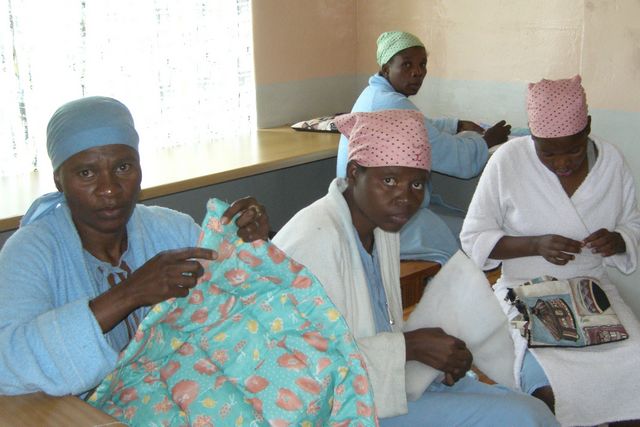

19 Nov. 2006 Blog
This week before American Thanksgiving was full of wet stormy weather, a little bit of cabin fever on those stormy days, some serious farming and a few successes in starting the men on appropriate craft projects. We are deep into the rainy season which means heavy LA style rainstorms accompanied by thunder and lightning. The air temperatures are warm but the heavy mist and moisture make a beach loving So Cal Gal feel chilly in the roost in the sky. The skies brightened one day so we took advantage and made furrows in the plowed field for cabbage and planted radishes, cucumbers, eggplant and carrots. What an indulgence to be limited only by one’s energy and the seeds that are available instead of the land! However, hoeing, pulling all the clods and grass is hard work and the limitlessness of the fabulous soil only reinforces the frailties of the body. Farming is a pleasure after minding the hospital business all day while hearing the beguiling birdcalls just outside the windows of the office.
The men were a little skeptical when they were given wire, fine copper, wire cutters and pliers to start some handwork on Monday. I gave them prototypes of crafts that had been purchased in gift shops in Vryheid made from wire and beads including darling butterflies, lizards, baskets fashioned from colored telephone wire, and star-shaped key chains. The men live 8 to a ward with four beds on each side and a nurse’s stand in the middle of the room that looks down the 1000 ft drop to the valley and the ancient Zulu head formation in the rocky cliff. Some of them never look up and are so thin they can barely hold up their pajamas. However, a few were slightly interested, including the tailor, a handsome man in his twenties from Durban and a young 14 year old boy. The young man looked at the materials, quizzically turned his head and asked if he could make autos out of the wire. With this request, I was ecstatic, since the homemade wire cars with infinite details and features are the one toy that you see everywhere in Africa. He rounded up the 14 year old and they got busy bending, twisting and then scrounging the hospital grounds for the requisite wheels, mirrors, Mercedes symbols and trailer hitches in miniature. The handwork is not a two hour session in occupational therapy but a compulsion for these men. As soon as the materials are distributed, the patients begin to work and are engrossed until the craft is complete, albeit in their own way. The darling and “way too precious” objects that were for sale in the fine arts stores had little appeal to the patients, but their own ideas were original and fun for them. Likewise, some pink knit fabric that had been purchased for hats for the women was a bust, but a 16 year old girl sewed buttons and fringe unto the hat and made a bustier that suited her to a T and gave everyone a good laugh. We are all learning what works and what doesn’t. However it is gratifying to see the women throughout the hospital and grounds knitting, crocheting, sewing and chattering. Next week’s agenda includes a collage with stuffed cloth butterflies, lizard and bugs, aprons to sew and pillows from assorted African fabrics. It is interesting to note how the Peace Corps draws on skills mainly learned before the age of 10! The women were clamoring for foam stuffing for their pillows so Brendon and I were certainly a site hiking the 2 km in to the hospital on the dirt road today (our regular taxi driver did not show up for our return from Vryheid) laden with 2 large bags of foam stuffing, one meter of batting, 10 meters of fabric, groceries, perishables, books, clothes for church, backpack and laptop. We weren’t fazed a bit except about halfway through the trek home, I noticed Brendon dribbling bits of colored foam scrap out of the bag just like Hansel and Gretel. He certainly has been good natured about all of the visits to the fabric stores which may have to be curtailed until Mr. Zulu returns to the taxi run down the 2 km drive into the hospital.
On a sadder note, we attended a funeral this week for an American women who served in the Peace Corps in Liberia in the 80’s and has since worked in social projects throughout the world, especially for vulnerable children and orphans. We had lunch with her last weekend in a serendipity moment as we saw her at a lovely outdoor restaurant near our bed and breakfast and joined her. She expressed some of her ideas for teaching lifeskills to the children taking care of younger children and discussed the African idea of keeping orphans in their village. The AIDS pandemic in Africa is hitting the breadwinners and parents, leaving the children behind to fend for themselves. This problem will continue for many years and is truly a handicap to this blossoming nation. The children of Africa deserve a great deal of respect as they manage to cut the wood, chase after the cattle and goats with a stick, cook the food, fetch water that may be several kilometers away, purchase kerosene for the cookstoves and take care of babies in the family. They are not coddled like American children, have no books or toys for their entertainment, but are courteous, respectful and well behaved. (at least in the rural environments that have been our experience). Their potential is as wide as their beautiful smiles. However, AIDS and lack of access to educational facilities has shrunk their opportunities for the life that utilizes their potential. Well, Goodbye Faye and Rest Assured that your hard work will continue to make amends to the children and open up opportunities for their future!
Happy Thanksgiving to our friends and family! We are thankful for the support from all of you and for this opportunity to learn and grow. God bless you all. We do not feel deprived in any way, especially since it is Spring here and Summer is rapidly approaching. The stores are beginning to stock the plum pudding, Christmas crackers, and holiday bling but they are absent the recorded music and frenetic consumer atmosphere. So it feels like March to us with June around the corner. See you at the Beach!
This week before American Thanksgiving was full of wet stormy weather, a little bit of cabin fever on those stormy days, some serious farming and a few successes in starting the men on appropriate craft projects. We are deep into the rainy season which means heavy LA style rainstorms accompanied by thunder and lightning. The air temperatures are warm but the heavy mist and moisture make a beach loving So Cal Gal feel chilly in the roost in the sky. The skies brightened one day so we took advantage and made furrows in the plowed field for cabbage and planted radishes, cucumbers, eggplant and carrots. What an indulgence to be limited only by one’s energy and the seeds that are available instead of the land! However, hoeing, pulling all the clods and grass is hard work and the limitlessness of the fabulous soil only reinforces the frailties of the body. Farming is a pleasure after minding the hospital business all day while hearing the beguiling birdcalls just outside the windows of the office.
The men were a little skeptical when they were given wire, fine copper, wire cutters and pliers to start some handwork on Monday. I gave them prototypes of crafts that had been purchased in gift shops in Vryheid made from wire and beads including darling butterflies, lizards, baskets fashioned from colored telephone wire, and star-shaped key chains. The men live 8 to a ward with four beds on each side and a nurse’s stand in the middle of the room that looks down the 1000 ft drop to the valley and the ancient Zulu head formation in the rocky cliff. Some of them never look up and are so thin they can barely hold up their pajamas. However, a few were slightly interested, including the tailor, a handsome man in his twenties from Durban and a young 14 year old boy. The young man looked at the materials, quizzically turned his head and asked if he could make autos out of the wire. With this request, I was ecstatic, since the homemade wire cars with infinite details and features are the one toy that you see everywhere in Africa. He rounded up the 14 year old and they got busy bending, twisting and then scrounging the hospital grounds for the requisite wheels, mirrors, Mercedes symbols and trailer hitches in miniature. The handwork is not a two hour session in occupational therapy but a compulsion for these men. As soon as the materials are distributed, the patients begin to work and are engrossed until the craft is complete, albeit in their own way. The darling and “way too precious” objects that were for sale in the fine arts stores had little appeal to the patients, but their own ideas were original and fun for them. Likewise, some pink knit fabric that had been purchased for hats for the women was a bust, but a 16 year old girl sewed buttons and fringe unto the hat and made a bustier that suited her to a T and gave everyone a good laugh. We are all learning what works and what doesn’t. However it is gratifying to see the women throughout the hospital and grounds knitting, crocheting, sewing and chattering. Next week’s agenda includes a collage with stuffed cloth butterflies, lizard and bugs, aprons to sew and pillows from assorted African fabrics. It is interesting to note how the Peace Corps draws on skills mainly learned before the age of 10! The women were clamoring for foam stuffing for their pillows so Brendon and I were certainly a site hiking the 2 km in to the hospital on the dirt road today (our regular taxi driver did not show up for our return from Vryheid) laden with 2 large bags of foam stuffing, one meter of batting, 10 meters of fabric, groceries, perishables, books, clothes for church, backpack and laptop. We weren’t fazed a bit except about halfway through the trek home, I noticed Brendon dribbling bits of colored foam scrap out of the bag just like Hansel and Gretel. He certainly has been good natured about all of the visits to the fabric stores which may have to be curtailed until Mr. Zulu returns to the taxi run down the 2 km drive into the hospital.
On a sadder note, we attended a funeral this week for an American women who served in the Peace Corps in Liberia in the 80’s and has since worked in social projects throughout the world, especially for vulnerable children and orphans. We had lunch with her last weekend in a serendipity moment as we saw her at a lovely outdoor restaurant near our bed and breakfast and joined her. She expressed some of her ideas for teaching lifeskills to the children taking care of younger children and discussed the African idea of keeping orphans in their village. The AIDS pandemic in Africa is hitting the breadwinners and parents, leaving the children behind to fend for themselves. This problem will continue for many years and is truly a handicap to this blossoming nation. The children of Africa deserve a great deal of respect as they manage to cut the wood, chase after the cattle and goats with a stick, cook the food, fetch water that may be several kilometers away, purchase kerosene for the cookstoves and take care of babies in the family. They are not coddled like American children, have no books or toys for their entertainment, but are courteous, respectful and well behaved. (at least in the rural environments that have been our experience). Their potential is as wide as their beautiful smiles. However, AIDS and lack of access to educational facilities has shrunk their opportunities for the life that utilizes their potential. Well, Goodbye Faye and Rest Assured that your hard work will continue to make amends to the children and open up opportunities for their future!
Happy Thanksgiving to our friends and family! We are thankful for the support from all of you and for this opportunity to learn and grow. God bless you all. We do not feel deprived in any way, especially since it is Spring here and Summer is rapidly approaching. The stores are beginning to stock the plum pudding, Christmas crackers, and holiday bling but they are absent the recorded music and frenetic consumer atmosphere. So it feels like March to us with June around the corner. See you at the Beach!
Sunday, November 12, 2006
Sewing Sighs
11 Nov. 2006
Tonight is Saturday night and we are spending it in our cozy flat at Mountain High with the mist hanging like pea soup and the wind whistling through the windows on three sides of our living area. We traveled to our home town, 80 km by taxi van, today, to get groceries and managed to return on the only local taxi at 1145am with packages of cheese, meat, vegetables, pasta, onions, garlic, ginger, candy (for emergencies) and loads of fabric, yarn, crochet hooks, knitting needles, wire and wire cutters for next week’s craft projects with the patients. We left the mountain at 6 am this morning, watching the village women load long bundles of cut trees onto their heads (twala) for carting down to the village for cooking and heating. Our taxi driver, Mr. Zulu, is infinitely polite but expectantly hands a lotto card to Brendon each week, hoping that the Umlungu (the whites) will provide winning numbers. Alas, although Brendon does his best at picking the lucky numbers; each week has been a bust. We leave Mountain High at its misty moisty best and travel down through the forests, rocky landforms, termite hills and hillside kraals (farms) to lower ground with sunny skies. We arrive around 7 am every Sat morning when the shops are still closed but we are country people with big eyes for the delights of the small town and hit the post office looking for mail and sometimes the lone coffee shop for a cup of real coffee and a sugar filled crepe for 1 and a half rand (ten cents). By 8 or 830 the shops open and we have a big list but small carrying capacity for the items to get us through the week and serve as recreation and therapy for the patients at Mountain View. The town looks like a small town in the San Joaquin Valley with its version of department stores, drug stores, and grocery stores but amazingly has 5 fabric stores as the local residents are excellent seamstresses. Thus I am cultivating relationships with the shopkeepers who wonder why this crazy American woman (with husband in tow) is looking for bunting, buttons, patterns and cheap cotton.
The week had some highs and lows. After the great start with the ancient blue Ganda Ganda Tractor coming to life, the sewing project had a day of isipithipithi (chaos or confusion). Tuesday started out on a very positive note as the women and men gathered to work their quilt, bootie, and tote bag crafts and were interrupted by the hospital director announcing that we had a visitor. Graham Root, a founder of the Itahla Game Preserve, former game warden, author of many South African books (including one where he adopts the mindset of a Rhino and Ostrich) and current operator of a game preserve, arrived at Mountain High to meet the Americans and proffer advice on gardening and Zulu crafts. This was an exciting event as Graham Root is a cult figure in these parts and understands Zulu. We had heard his name since our arrival in Zululand and wanted to get his advice about how best to proceed to find culturally sensitive craft projects, especially for the men. I left the sewing group to show him around the garden, have tea and pick his brain about gardening and craft ideas. He had lots of good advice about crops and crafts. By the time I returned to the TV room used for sewing, I was upset to see that almost all of the fabric had disappeared as well as the thread and scissors. This was a big blow as there were no projects for the next day and I was disturbed that the patients would not show more respect for the ownership and distribution of materials. Even the binding material for our group community quilt, which was to be hung in the maternity ward, had disappeared. I was angry and mad at myself for not safely putting the fabrics away before taking off on the tour with Graham Root. That night I was sleepless trying to think of how to make a program happen the next day and finally remembered an extra blue plaid sheet that I had brought to South Africa with our sleeping bags as bedding for the initial training. So we could at least make quilts out of old sheets just like our ancestors used to do. I have previously joked with the patients that my husband’s grandmother made quilts out of her husband’s underwear and that this was considered “Art”and hung on the wall of our home in Palos Verdes.
Wednesday morning arrived and I was in a sour mood as I arrived at 1030am in the TV room with my dirty sheet to try to make a craft program happen. I could not find the 3 meters of bunting that had been purchased to fill the quilts and immediately suspected that it had also been lifted. A nurse came in and scolded the patients for absconding with all of the fabrics, thread, bunting and scissors. To flame my anger, one of the women walked in with the green fleece fabric just wrapped around her head in twala with no sewing or any effort, just a warm fabric to ward off the chill of the day and add a little variety and fun to her life. The women sensed my anger and started bantering among themselves and talking with the nurse. The women with the green twala walked out and returned with the modest induku (head scarf) she had made the week before. My angst about materials disappearing was wrecking havoc on the budding relations that had been forming with the women and the incipient program for patient therapy. The patients were anxious, I was unhappy and the needed patient recreation therapy was hassle for everyone with many misunderstandings. After locating the bunting in my flat and apologizing to the patients, I started cutting the blue plaid sheet so that the women could continue their quilts and we finally had some enjoyable work going, albeit with a rocky start. The patient that had stashed the green fleece willingly gave it up so that another women could make booties and a patient’s secret hoard of heavy tote bag fabric was shared with a new patient who wanted to make a bag. Peace returned!
Thursday arrived with some trepidation as to where the sewing projects were headed and my realization that more support was needed from the hospital and community to keep our craft time going. I arrived in the TV room early and did my usual “Jabulele” (Happy Time). Within a few seconds, all of the angst and negative thoughts about the sewing program disappeared as Zenile, a young 16 year old girl, walked in with two folk dolls, made out hoarded fabric scraps, wrapped in the pink patchwork quilt she had made. The dolls were wonderful examples of folk art with their stitched heads, tall green Zulu hats, breasts, skirts and Zulu print leggings. Zenile will be in the hospital for 3 months; her mother is in a hospital somewhere in Durban. Zenile cuddled the dolls as if they were real babies. Maybe the best work comes from letting go and freeing others to create beauty. An additional surprise that morning was the tailor’s creation of an intricate cosmetic bag designed from scraps of the Zulu printed fabrics. The fabric with the Zulu shields, three legged pots and rondavals was matched with an African geometric print and lined in grey taffeta. His first statement was a request for a zipper to sew into the carefully made folds to close up the cosmetic case.
As you can see each day has its charms and challenges but also a huge bequest of love and kindness from the Zulu community. We are seeking ways to make the projects sustainable and representative of Zulu culture. The garden has sprouted and many hours were spent leveling the large field that was dug up by the ganda ganda. The seeds are here and it is time to plant, hoe, rake and weed!
Tonight is Saturday night and we are spending it in our cozy flat at Mountain High with the mist hanging like pea soup and the wind whistling through the windows on three sides of our living area. We traveled to our home town, 80 km by taxi van, today, to get groceries and managed to return on the only local taxi at 1145am with packages of cheese, meat, vegetables, pasta, onions, garlic, ginger, candy (for emergencies) and loads of fabric, yarn, crochet hooks, knitting needles, wire and wire cutters for next week’s craft projects with the patients. We left the mountain at 6 am this morning, watching the village women load long bundles of cut trees onto their heads (twala) for carting down to the village for cooking and heating. Our taxi driver, Mr. Zulu, is infinitely polite but expectantly hands a lotto card to Brendon each week, hoping that the Umlungu (the whites) will provide winning numbers. Alas, although Brendon does his best at picking the lucky numbers; each week has been a bust. We leave Mountain High at its misty moisty best and travel down through the forests, rocky landforms, termite hills and hillside kraals (farms) to lower ground with sunny skies. We arrive around 7 am every Sat morning when the shops are still closed but we are country people with big eyes for the delights of the small town and hit the post office looking for mail and sometimes the lone coffee shop for a cup of real coffee and a sugar filled crepe for 1 and a half rand (ten cents). By 8 or 830 the shops open and we have a big list but small carrying capacity for the items to get us through the week and serve as recreation and therapy for the patients at Mountain View. The town looks like a small town in the San Joaquin Valley with its version of department stores, drug stores, and grocery stores but amazingly has 5 fabric stores as the local residents are excellent seamstresses. Thus I am cultivating relationships with the shopkeepers who wonder why this crazy American woman (with husband in tow) is looking for bunting, buttons, patterns and cheap cotton.
The week had some highs and lows. After the great start with the ancient blue Ganda Ganda Tractor coming to life, the sewing project had a day of isipithipithi (chaos or confusion). Tuesday started out on a very positive note as the women and men gathered to work their quilt, bootie, and tote bag crafts and were interrupted by the hospital director announcing that we had a visitor. Graham Root, a founder of the Itahla Game Preserve, former game warden, author of many South African books (including one where he adopts the mindset of a Rhino and Ostrich) and current operator of a game preserve, arrived at Mountain High to meet the Americans and proffer advice on gardening and Zulu crafts. This was an exciting event as Graham Root is a cult figure in these parts and understands Zulu. We had heard his name since our arrival in Zululand and wanted to get his advice about how best to proceed to find culturally sensitive craft projects, especially for the men. I left the sewing group to show him around the garden, have tea and pick his brain about gardening and craft ideas. He had lots of good advice about crops and crafts. By the time I returned to the TV room used for sewing, I was upset to see that almost all of the fabric had disappeared as well as the thread and scissors. This was a big blow as there were no projects for the next day and I was disturbed that the patients would not show more respect for the ownership and distribution of materials. Even the binding material for our group community quilt, which was to be hung in the maternity ward, had disappeared. I was angry and mad at myself for not safely putting the fabrics away before taking off on the tour with Graham Root. That night I was sleepless trying to think of how to make a program happen the next day and finally remembered an extra blue plaid sheet that I had brought to South Africa with our sleeping bags as bedding for the initial training. So we could at least make quilts out of old sheets just like our ancestors used to do. I have previously joked with the patients that my husband’s grandmother made quilts out of her husband’s underwear and that this was considered “Art”and hung on the wall of our home in Palos Verdes.
Wednesday morning arrived and I was in a sour mood as I arrived at 1030am in the TV room with my dirty sheet to try to make a craft program happen. I could not find the 3 meters of bunting that had been purchased to fill the quilts and immediately suspected that it had also been lifted. A nurse came in and scolded the patients for absconding with all of the fabrics, thread, bunting and scissors. To flame my anger, one of the women walked in with the green fleece fabric just wrapped around her head in twala with no sewing or any effort, just a warm fabric to ward off the chill of the day and add a little variety and fun to her life. The women sensed my anger and started bantering among themselves and talking with the nurse. The women with the green twala walked out and returned with the modest induku (head scarf) she had made the week before. My angst about materials disappearing was wrecking havoc on the budding relations that had been forming with the women and the incipient program for patient therapy. The patients were anxious, I was unhappy and the needed patient recreation therapy was hassle for everyone with many misunderstandings. After locating the bunting in my flat and apologizing to the patients, I started cutting the blue plaid sheet so that the women could continue their quilts and we finally had some enjoyable work going, albeit with a rocky start. The patient that had stashed the green fleece willingly gave it up so that another women could make booties and a patient’s secret hoard of heavy tote bag fabric was shared with a new patient who wanted to make a bag. Peace returned!
Thursday arrived with some trepidation as to where the sewing projects were headed and my realization that more support was needed from the hospital and community to keep our craft time going. I arrived in the TV room early and did my usual “Jabulele” (Happy Time). Within a few seconds, all of the angst and negative thoughts about the sewing program disappeared as Zenile, a young 16 year old girl, walked in with two folk dolls, made out hoarded fabric scraps, wrapped in the pink patchwork quilt she had made. The dolls were wonderful examples of folk art with their stitched heads, tall green Zulu hats, breasts, skirts and Zulu print leggings. Zenile will be in the hospital for 3 months; her mother is in a hospital somewhere in Durban. Zenile cuddled the dolls as if they were real babies. Maybe the best work comes from letting go and freeing others to create beauty. An additional surprise that morning was the tailor’s creation of an intricate cosmetic bag designed from scraps of the Zulu printed fabrics. The fabric with the Zulu shields, three legged pots and rondavals was matched with an African geometric print and lined in grey taffeta. His first statement was a request for a zipper to sew into the carefully made folds to close up the cosmetic case.
As you can see each day has its charms and challenges but also a huge bequest of love and kindness from the Zulu community. We are seeking ways to make the projects sustainable and representative of Zulu culture. The garden has sprouted and many hours were spent leveling the large field that was dug up by the ganda ganda. The seeds are here and it is time to plant, hoe, rake and weed!
Monday, November 06, 2006
Ganda Ganda-Let It Rip!!
6 Nov. 2006
Well, today was one of the most exiting of my Peace Corps experience and maybe one of the most gratifying of my life. Late this afternoon, the Mountain High tractor rolled down the road from its ancient burial site and charged into action on the beautiful farmland in front of our home. The driver cautiously watched every inch forward and religiously turned to clean the weeds and debris off the blades. The Zulus call the tractor the Ganda Ganda and all I could think of was Granda Granda. Brendon and I have been struggling for three weeks to plow up the one acre plot with a shovel and fork but have only a few pitiful squares to show for our efforts. Today our plan was to weed our small plot with tomatoes, beans, parsley, lettuce and delicious herbs (basil,thyme and parsley) and plant the mealy (corn) plants in the larger square. We have been given lots of advice about farming this beautiful soil which is endowed with loads of rain (plus the dramatic thunder and lightning shows here at the top of the mountain with a chaser of mist and rain) and the perfect mix of clay and sand. Our pharmacist had promised mealy for any dirt we could turn up. Low and behold a team of local men worked on the tractor and brought it to life. We started this garden project as a way of providing food and entertainment for ourselves with a small hope that it would catch on. Now comes the hard problem of what to plant, how to encourage work, how to get a governing body for the garden that will make the decisions and distribute the food. There are plenty of takers for food in the area; besides the obvious patients, employees and residents in the small village 1000ft below the hospital there are the 60 boys boarding at the high school that cook their own food and are cared for by one adult. I give them credit as they are always well dressed and appear well nourished. I don’t know how they do it without a fast food restaurant or grocery store nearby. So this has been a tentative step forward. We are testing the waters with foods that are enjoyed by the locals but have only seem limited steps that they want to jump in and make this food factory happen. They have been handicapped with the grief and subsequent mourning from the many AIDS funerals we have experienced lately among local residents and employees and are probably unsure as to our motivations.
Ironically we watched a recent video about Mountain High in the 80’s where the facility raised animals, manufactured candles, grew their own food, ran the schools, clinics and hospitals. Today the site has lost some of its self-sufficiency but is on the way back with a visionary African leader who wants to take advantage of the bountiful resources.
The last week was more productive in terms of our efforts to provide meaningful activity for the patients and contribute to the management of the hospital. Although, the patchwork quilts were a limited success as they are not part of the Zulu culture and some women complained that cutting the small squares was too time-consuming (although that was the point and this is an artistic creative endeavor) we have been sewing booties out of fleece fabric. The nights (and some days) are very cold here at Mountain High and the patients are looking for warm apparel. Thus the booties were an instant hit. We started off with fleece in a beautiful butterfly pattern where I cut sock shapes out of a cardboard pattern and examined the patient’s feet to estimate the size. The day was warm when we started so I moved the women out to the beautiful garden to sew. Lo and behold a Man showed up who said he wanted to make the booties. I was thrilled and gave him some booties to sew. I was concerned when he did not tie a knot in the thread and he indignantly responded that he was a professional couture tailor from Durban and he certainly knew how to finish and start seams. He graciously forgave my ignorance and by today he was cutting out red fleece booties for all the men that could sew as well as adorable tall green fleece hats for his buddies who have very short hair and are chilly from the cold weather and the draughty wards. By nightfall the men and women were fighting over the spools of thread. The men were claiming that they deserved at least one of the spools and the women were hoarding the thread because of the old rule of possession. I was so happy to see some activity in the hospital and some joy in everyone’s life.
Friday was cooking day so this week we made Crazy Chocolate Cake, another blast from the 50’s. Unfortunately, crazy does not translate in Zulu (it means truly mad) but I asked the women patients to each have a joke in Zulu to make each other laugh. The only real laughs I heard was when I tried to Toy Toy (picture the Rockettes with an edge) to a South African liberation song Shosolooza and they all joined in. Soon even the patient who does not have the eyes to sew joined the group who were all singing and dancing and enjoying the day. Everyone loved the moist delicious cake which requires no mixing bowl, eggs, butter or milk but disappears in an instant after baking. Blest be those frugal cooks from the 50’s who passed on the recipes to Peace Corps volunteers who pass on a little American culture, whether it is a good idea or not. Next week maybe I will try Pizza, but better still would be to get the women to describe one of their recipes or practices from their culture. We are all still learning from each other! Brendon on the other hand has been given the task of a major programming job where he will use his skills from his aerospace job. Peace Corps has many manifestations which is great for us old timers where the past can also assist the present. All is not perfect in Paradise however, as we learned this week that new credit cards in the US that replaced expired credit cards had been maxed out and South African Airlines does not do business like US airlines. Apartheid has taken its toll on business, efficiency and trust that is required in an electronic society. Plus the small business matters in rural South Africa are intensely complicated without access to reliable phones, fax, post or internet.
Missing you all as I hit all the many fabric stores in Vryheid and try to figure out how to make this sustainable! (Thanks to our neighbor in Palos Verdes (Mrs. G) who provided the seed money for the fabric and hose to water the bounteous garden.)
Well, today was one of the most exiting of my Peace Corps experience and maybe one of the most gratifying of my life. Late this afternoon, the Mountain High tractor rolled down the road from its ancient burial site and charged into action on the beautiful farmland in front of our home. The driver cautiously watched every inch forward and religiously turned to clean the weeds and debris off the blades. The Zulus call the tractor the Ganda Ganda and all I could think of was Granda Granda. Brendon and I have been struggling for three weeks to plow up the one acre plot with a shovel and fork but have only a few pitiful squares to show for our efforts. Today our plan was to weed our small plot with tomatoes, beans, parsley, lettuce and delicious herbs (basil,thyme and parsley) and plant the mealy (corn) plants in the larger square. We have been given lots of advice about farming this beautiful soil which is endowed with loads of rain (plus the dramatic thunder and lightning shows here at the top of the mountain with a chaser of mist and rain) and the perfect mix of clay and sand. Our pharmacist had promised mealy for any dirt we could turn up. Low and behold a team of local men worked on the tractor and brought it to life. We started this garden project as a way of providing food and entertainment for ourselves with a small hope that it would catch on. Now comes the hard problem of what to plant, how to encourage work, how to get a governing body for the garden that will make the decisions and distribute the food. There are plenty of takers for food in the area; besides the obvious patients, employees and residents in the small village 1000ft below the hospital there are the 60 boys boarding at the high school that cook their own food and are cared for by one adult. I give them credit as they are always well dressed and appear well nourished. I don’t know how they do it without a fast food restaurant or grocery store nearby. So this has been a tentative step forward. We are testing the waters with foods that are enjoyed by the locals but have only seem limited steps that they want to jump in and make this food factory happen. They have been handicapped with the grief and subsequent mourning from the many AIDS funerals we have experienced lately among local residents and employees and are probably unsure as to our motivations.
Ironically we watched a recent video about Mountain High in the 80’s where the facility raised animals, manufactured candles, grew their own food, ran the schools, clinics and hospitals. Today the site has lost some of its self-sufficiency but is on the way back with a visionary African leader who wants to take advantage of the bountiful resources.
The last week was more productive in terms of our efforts to provide meaningful activity for the patients and contribute to the management of the hospital. Although, the patchwork quilts were a limited success as they are not part of the Zulu culture and some women complained that cutting the small squares was too time-consuming (although that was the point and this is an artistic creative endeavor) we have been sewing booties out of fleece fabric. The nights (and some days) are very cold here at Mountain High and the patients are looking for warm apparel. Thus the booties were an instant hit. We started off with fleece in a beautiful butterfly pattern where I cut sock shapes out of a cardboard pattern and examined the patient’s feet to estimate the size. The day was warm when we started so I moved the women out to the beautiful garden to sew. Lo and behold a Man showed up who said he wanted to make the booties. I was thrilled and gave him some booties to sew. I was concerned when he did not tie a knot in the thread and he indignantly responded that he was a professional couture tailor from Durban and he certainly knew how to finish and start seams. He graciously forgave my ignorance and by today he was cutting out red fleece booties for all the men that could sew as well as adorable tall green fleece hats for his buddies who have very short hair and are chilly from the cold weather and the draughty wards. By nightfall the men and women were fighting over the spools of thread. The men were claiming that they deserved at least one of the spools and the women were hoarding the thread because of the old rule of possession. I was so happy to see some activity in the hospital and some joy in everyone’s life.
Friday was cooking day so this week we made Crazy Chocolate Cake, another blast from the 50’s. Unfortunately, crazy does not translate in Zulu (it means truly mad) but I asked the women patients to each have a joke in Zulu to make each other laugh. The only real laughs I heard was when I tried to Toy Toy (picture the Rockettes with an edge) to a South African liberation song Shosolooza and they all joined in. Soon even the patient who does not have the eyes to sew joined the group who were all singing and dancing and enjoying the day. Everyone loved the moist delicious cake which requires no mixing bowl, eggs, butter or milk but disappears in an instant after baking. Blest be those frugal cooks from the 50’s who passed on the recipes to Peace Corps volunteers who pass on a little American culture, whether it is a good idea or not. Next week maybe I will try Pizza, but better still would be to get the women to describe one of their recipes or practices from their culture. We are all still learning from each other! Brendon on the other hand has been given the task of a major programming job where he will use his skills from his aerospace job. Peace Corps has many manifestations which is great for us old timers where the past can also assist the present. All is not perfect in Paradise however, as we learned this week that new credit cards in the US that replaced expired credit cards had been maxed out and South African Airlines does not do business like US airlines. Apartheid has taken its toll on business, efficiency and trust that is required in an electronic society. Plus the small business matters in rural South Africa are intensely complicated without access to reliable phones, fax, post or internet.
Missing you all as I hit all the many fabric stores in Vryheid and try to figure out how to make this sustainable! (Thanks to our neighbor in Palos Verdes (Mrs. G) who provided the seed money for the fabric and hose to water the bounteous garden.)
Sunday, October 29, 2006
Quilting Bee Mountain High Style
Last week I left you in suspense as the “Mountain High Sewing Circle” was inaugurated with little fanfare but a lot of apprehension on my part. What if none of the patients liked the projects or wanted to sew? What if nobody showed up? What if the projects were too hard/easy/fast/slow/boring? What if my slapdash sewing ability did not go over in this country where an iron is a necessity, even for families without electricity. (By the way, Join the Peace Corps and you will probably need an iron). What if there weren’t enough needles, fabric, thread or patience (patients)? What if the patients didn’t know how to sew and didn’t want to learn? What if our projects interfered with the nurses and we are scolded for wanting to have a few laughs and fun in this hospital environment? Well, the week was generally viewed as a success because every day we had 10-15 women who left their beds to come and sew and join the fun. They were disappointed when I told them on Friday that we would not meet on the weekends as it takes all weekend for me to obtain groceries in this remote outpost. I believe that the blessings fell on all of us even though some of the projects were not culturally sensitive. The time was well spent and I got to know the women as individuals with lives, families, aspirations, boyfriends, vanity and an urge to embrace the future.
Monday, after advising the director of nursing of my intentions to start handwork (she is called the Matron), the nurses rounded up the willing and able to sit in the corridor on benches while I showed them the headscarf (induku) project and had them draw numbers out of a hat to determine who would get to select the first piece of fabric that would be hemmed. I had purchased 5 types of soft cotton in one of the many fabric stores in town and cut them into 50cm squares for hemming. We started with a prayer and hymn as all meetings do in South Africa, sacred and secular. The 17 women enjoyed selecting their printed or plain fabric and I was glad there appeared to be no “dog” in the selection. One of the patients is only 19 years old and she asked for PINK, just like the young girls in the US. After 2 hours most of the women had finished hemming their indukus and put them on their heads. Twala or wrapping the induku is an art in this country with double, twisted and formed roses appearing on the women’s necks. The best part of the morning was hearing the women chatter and gossip, comparing their lives and sewing abilities.
I was at a loss for what to do on Tuesday so I showed them embroidery stitches they could use on their induku to personalize it. So we had an embroidery lesson where we did initials and names on the induku from Monday. Most of the women came back for more. By Wednesday I was brainstorming to figure out what we could do with only some scraps of fabric left from the indukus so we cut squares and triangles and started working on a quilt for the maternity ward. The women seemed unfamiliar with the idea of patchwork but caught on quickly and enjoyed deciding between square or pinwheel designs for the final assembly. I told them that this was an Ubuntu Ingubo or Community Blanket as each women assembled a patchwork square of small triangles and then sewed them unto the larger quiltop.
By Friday, it was time to celebrate the week’s accomplishments so I dragged my hotplate into the hospital TV room and showed them how to make NO BAKE Cookies, a blast from the 50’s (Thanks to all those moms who taught us useful life skills and sent the NOBakes to camp.) South Africans are partial to sweets-Don’t ever try to work through their Tea Break at 10am. The sweets (candy to us) aisles in the grocery, sundry, housewares and department stores are enormous with many new delights that would charm any expat including chocolate covered turkish delight, nougats with real cherries and almonds, and tiny chocolates in the shapes of ballet slippers with pink decorations. However, good luck trying to find paper towels, ziplock bags or pork chops!
After the cooking demonstration and sampling the goodies tackled the quilt which by now is getting larger and more complex. A few dedicated souls battled the glitches but sewing was competing with the wrestling match on TV. I was happy to hear gales of laughter as clowns hauled away losing wrestlers and the ladies cheered their heroes. A great time was had by all!! Tomorrow we start on booties made out of fleece, lap quilts and tote bags with the birds of South Africa (made from leftover fabric from my curtains). I don’t know where this handwork project is going but was heartened when a new nurse volunteered to assist with handcrafts at the employee staff meeting. Hopefully she will help plan projects that are better fits for the culture and are sensitive to the skills of the patients. The men are also restless in their long days with nothing to do and time to think about their illnesses and problems. Gardening may not be possible for them due to health issues so the next task may be to research appropriate handcrafts for them.
This week I have been thinking about the fragility of health, life and the impacts of disease on family relationships. My good friend Melinda's three year old grandaughter has just been diagnosed with Leukemia and the whole family has been affected. (Please say a prayer for Melinda and her family). The seriously ill patients here are mainly in their 30’s and 40’s when they should be supporting families and contributing to society. The TB and HIV prey upon each other so that two diseases must be treated. The patients are treated well but many do not have a good prognosis. The hospital is remote so that it is difficult for the families to visit. Every family here (patients and staff alike) has been affected by HIV and it is the breadwinners who have been removed from their roles, leaving the families bereaving and broke. There is little anger about this sad state of affairs; only a bland statement that a mother, father, or brother or sister “Passed Away.” Pray that a vaccine or cure for this plague will be found soon.
Monday, after advising the director of nursing of my intentions to start handwork (she is called the Matron), the nurses rounded up the willing and able to sit in the corridor on benches while I showed them the headscarf (induku) project and had them draw numbers out of a hat to determine who would get to select the first piece of fabric that would be hemmed. I had purchased 5 types of soft cotton in one of the many fabric stores in town and cut them into 50cm squares for hemming. We started with a prayer and hymn as all meetings do in South Africa, sacred and secular. The 17 women enjoyed selecting their printed or plain fabric and I was glad there appeared to be no “dog” in the selection. One of the patients is only 19 years old and she asked for PINK, just like the young girls in the US. After 2 hours most of the women had finished hemming their indukus and put them on their heads. Twala or wrapping the induku is an art in this country with double, twisted and formed roses appearing on the women’s necks. The best part of the morning was hearing the women chatter and gossip, comparing their lives and sewing abilities.
I was at a loss for what to do on Tuesday so I showed them embroidery stitches they could use on their induku to personalize it. So we had an embroidery lesson where we did initials and names on the induku from Monday. Most of the women came back for more. By Wednesday I was brainstorming to figure out what we could do with only some scraps of fabric left from the indukus so we cut squares and triangles and started working on a quilt for the maternity ward. The women seemed unfamiliar with the idea of patchwork but caught on quickly and enjoyed deciding between square or pinwheel designs for the final assembly. I told them that this was an Ubuntu Ingubo or Community Blanket as each women assembled a patchwork square of small triangles and then sewed them unto the larger quiltop.
By Friday, it was time to celebrate the week’s accomplishments so I dragged my hotplate into the hospital TV room and showed them how to make NO BAKE Cookies, a blast from the 50’s (Thanks to all those moms who taught us useful life skills and sent the NOBakes to camp.) South Africans are partial to sweets-Don’t ever try to work through their Tea Break at 10am. The sweets (candy to us) aisles in the grocery, sundry, housewares and department stores are enormous with many new delights that would charm any expat including chocolate covered turkish delight, nougats with real cherries and almonds, and tiny chocolates in the shapes of ballet slippers with pink decorations. However, good luck trying to find paper towels, ziplock bags or pork chops!
After the cooking demonstration and sampling the goodies tackled the quilt which by now is getting larger and more complex. A few dedicated souls battled the glitches but sewing was competing with the wrestling match on TV. I was happy to hear gales of laughter as clowns hauled away losing wrestlers and the ladies cheered their heroes. A great time was had by all!! Tomorrow we start on booties made out of fleece, lap quilts and tote bags with the birds of South Africa (made from leftover fabric from my curtains). I don’t know where this handwork project is going but was heartened when a new nurse volunteered to assist with handcrafts at the employee staff meeting. Hopefully she will help plan projects that are better fits for the culture and are sensitive to the skills of the patients. The men are also restless in their long days with nothing to do and time to think about their illnesses and problems. Gardening may not be possible for them due to health issues so the next task may be to research appropriate handcrafts for them.
This week I have been thinking about the fragility of health, life and the impacts of disease on family relationships. My good friend Melinda's three year old grandaughter has just been diagnosed with Leukemia and the whole family has been affected. (Please say a prayer for Melinda and her family). The seriously ill patients here are mainly in their 30’s and 40’s when they should be supporting families and contributing to society. The TB and HIV prey upon each other so that two diseases must be treated. The patients are treated well but many do not have a good prognosis. The hospital is remote so that it is difficult for the families to visit. Every family here (patients and staff alike) has been affected by HIV and it is the breadwinners who have been removed from their roles, leaving the families bereaving and broke. There is little anger about this sad state of affairs; only a bland statement that a mother, father, or brother or sister “Passed Away.” Pray that a vaccine or cure for this plague will be found soon.
Monday, October 23, 2006
A Day with Zebras, Eland and Bleesbok-We're Really in Africa!
Oct. 22, 2006
Saturday morning brought fair skies, so, with anticipation, we ventured to the Vryheid nature preserve to see if the locals were correctly reporting that the backside contained zebras, eland and bleesbok. The preserve is located on the hill above the town and is a 10 minute walk from taxi stand where we arrive from our mountain home once a week to buy groceries. We opened the gate to the preserve and discovered that there was not a soul or vehicle anywhere in the vicinity. Thus, we trekked up the path to the top of the hill through forest canopies, wildflowers, hanging bird’s nests created by weaver birds and occasional sights dating from Boer War battles. The view of the town from the summit was stunning as the hills are green and the buttes of Zululand contrasted with the farms, dams, mealie tanks, coal heaps and orderliness of the town. We then ventured down a track and came to the backside of the preserve where we sighted beasts grazing in the distance and not a human sign anywhere. As we hiked closer to the animals we realized that we were seeing black striped zebras grazing next to herds of eland. The more than 100 zebras had mouse like faces and were content to stare at us until we got within 100 feet and then they trotted off to the next viewing spot. I am partial to zebras and giraffes because of the beauty and eleganat design of their coats. The bleesbok ignored us as they were busy prancing, jumping and chasing about. The eland were sparser but statelier, content to graze in the distance. The track continued for around 4 miles until it returned to the summit of the hill. The experience of seeing exotic animals in freedom to roam and graze was thrilling to us Americans and probably just a hint of what this country has to offer, not to mention the pleasure of a spring day with the wildflowers in full bloom.
The week held many surprises including a trip to Mona, a Zulu craft fair in a village 40 km from Mountain High. The associate hospital director organized the outing to identify any Zulu crafts that would be appropriate activity projects for our patients. We arrived around 6pm to find that most of the vendors had closed up for the night and were huddled in their makeshift plastic tarp temporary homes. They come to this site every month from all over South Africa and camp for the two week fair. Thunder and lightning started as we ventured across the huge market site. Many of the muthi (traditional medicines) dealers were still selling their herbal preparations, a sad statement as to the extent of the AIDS pandemic in South Africa, which is seen as a bewitching of the patient by another. One vendor showed us straw mats; another had beautifully carved wooden bowls, a third brought out black clay pots with interesting designs embossed in the clay. I was looking for Zulu beading or wire baskets but the small items had been packed away for the night. Maybe we’ll try again next month. Mona was certainly not the Zulu cultural center that I had envisioned; think of a flea market with the goods spread out on the ground and the proprietors camping next to the wares. However, the thunder and lightning storm highlighting the rolling hills of Mona with the black tarp homes of the dealers silhouetted was a dramatic, memorable site.
Wednesday we were surprised by a knock at our door when a young village girl came up the steep path from the small local village to visit us. We carried on a conversation in Zulu/English and I learned that her mother had just died and was buried the previous Saturday. I could sense her grief and sense of loss. She was interested in the computer and so I showed her how to type a simple letter and look at photos. Although she was bright and courteous, she stated that it was impossible to find a job in the area and she has no money for further education so her prospects for employment are dim. Sat. morning she walked by our taxi carrying a saw to harvest firewood for cooking. However the sight that really caught my attention was a woman bundling 4 trees, 13 feet long, and placing them on her head to thwala(balance them) and transport them back to her home down the very steep path. She executed the task with great skill, grace and rhythm as she moved in dance like steps from side to side laden with her heavy load.
This weekend I bought cotton fabric for the women patients to make induku (head scarves) that they can hem, embroider and take with them when they are discharged. So I am filled with anxiety tonight about how the project will go over and whether it meets the Peace Corps standards of sustainability after we are gone. The patients have no activities to fill their time and are often depressed about their status, so barring a comedy team coming to tell jokes or a Zulu story teller, we will start a hand sewing project tomorrow for the head scarves. I am hoping it will be a sharing event with the women encouraged to talk about sewing and colors. My dream is that it will lead to a more complex projects-perhaps creating baby quilts for the newborns that are delivered by the midwives here at the hospital. (One little girl was born Wednesday night and was swaddled in an old brown flannel blanket.) I thought of the cute baby quilts at home and the women of St. Peters by the Sea’s project to make a new baby quilt for every baby at the general hospital-a great idea for Mountain High but is it sensitive and is it sustainable? We sure have a lot to learn and make mistakes every day. However, our friends and colleagues here are warm hearted and forgiving.
Saturday morning brought fair skies, so, with anticipation, we ventured to the Vryheid nature preserve to see if the locals were correctly reporting that the backside contained zebras, eland and bleesbok. The preserve is located on the hill above the town and is a 10 minute walk from taxi stand where we arrive from our mountain home once a week to buy groceries. We opened the gate to the preserve and discovered that there was not a soul or vehicle anywhere in the vicinity. Thus, we trekked up the path to the top of the hill through forest canopies, wildflowers, hanging bird’s nests created by weaver birds and occasional sights dating from Boer War battles. The view of the town from the summit was stunning as the hills are green and the buttes of Zululand contrasted with the farms, dams, mealie tanks, coal heaps and orderliness of the town. We then ventured down a track and came to the backside of the preserve where we sighted beasts grazing in the distance and not a human sign anywhere. As we hiked closer to the animals we realized that we were seeing black striped zebras grazing next to herds of eland. The more than 100 zebras had mouse like faces and were content to stare at us until we got within 100 feet and then they trotted off to the next viewing spot. I am partial to zebras and giraffes because of the beauty and eleganat design of their coats. The bleesbok ignored us as they were busy prancing, jumping and chasing about. The eland were sparser but statelier, content to graze in the distance. The track continued for around 4 miles until it returned to the summit of the hill. The experience of seeing exotic animals in freedom to roam and graze was thrilling to us Americans and probably just a hint of what this country has to offer, not to mention the pleasure of a spring day with the wildflowers in full bloom.
The week held many surprises including a trip to Mona, a Zulu craft fair in a village 40 km from Mountain High. The associate hospital director organized the outing to identify any Zulu crafts that would be appropriate activity projects for our patients. We arrived around 6pm to find that most of the vendors had closed up for the night and were huddled in their makeshift plastic tarp temporary homes. They come to this site every month from all over South Africa and camp for the two week fair. Thunder and lightning started as we ventured across the huge market site. Many of the muthi (traditional medicines) dealers were still selling their herbal preparations, a sad statement as to the extent of the AIDS pandemic in South Africa, which is seen as a bewitching of the patient by another. One vendor showed us straw mats; another had beautifully carved wooden bowls, a third brought out black clay pots with interesting designs embossed in the clay. I was looking for Zulu beading or wire baskets but the small items had been packed away for the night. Maybe we’ll try again next month. Mona was certainly not the Zulu cultural center that I had envisioned; think of a flea market with the goods spread out on the ground and the proprietors camping next to the wares. However, the thunder and lightning storm highlighting the rolling hills of Mona with the black tarp homes of the dealers silhouetted was a dramatic, memorable site.
Wednesday we were surprised by a knock at our door when a young village girl came up the steep path from the small local village to visit us. We carried on a conversation in Zulu/English and I learned that her mother had just died and was buried the previous Saturday. I could sense her grief and sense of loss. She was interested in the computer and so I showed her how to type a simple letter and look at photos. Although she was bright and courteous, she stated that it was impossible to find a job in the area and she has no money for further education so her prospects for employment are dim. Sat. morning she walked by our taxi carrying a saw to harvest firewood for cooking. However the sight that really caught my attention was a woman bundling 4 trees, 13 feet long, and placing them on her head to thwala(balance them) and transport them back to her home down the very steep path. She executed the task with great skill, grace and rhythm as she moved in dance like steps from side to side laden with her heavy load.
This weekend I bought cotton fabric for the women patients to make induku (head scarves) that they can hem, embroider and take with them when they are discharged. So I am filled with anxiety tonight about how the project will go over and whether it meets the Peace Corps standards of sustainability after we are gone. The patients have no activities to fill their time and are often depressed about their status, so barring a comedy team coming to tell jokes or a Zulu story teller, we will start a hand sewing project tomorrow for the head scarves. I am hoping it will be a sharing event with the women encouraged to talk about sewing and colors. My dream is that it will lead to a more complex projects-perhaps creating baby quilts for the newborns that are delivered by the midwives here at the hospital. (One little girl was born Wednesday night and was swaddled in an old brown flannel blanket.) I thought of the cute baby quilts at home and the women of St. Peters by the Sea’s project to make a new baby quilt for every baby at the general hospital-a great idea for Mountain High but is it sensitive and is it sustainable? We sure have a lot to learn and make mistakes every day. However, our friends and colleagues here are warm hearted and forgiving.
Monday, October 16, 2006
Two Springs, Two Summers - What's Down the Road??
Oct. 16, 2006
Two Springs, Two Summers – What’s down the Road??
Our arrival here in South Africa has been confusing and comforting at the same time due to the familiarity of the climates to Los Angeles but the change in seasons and calendar. In July we arrived to late Winter after leaving Hawaii and Philadelphia Summer Weather. Plus, there is no central heating that we have seen anywhere in SA, even in tourist hotels. (Course our experience is very limited and confined to communities of Africans and Peace Corps training sites). So we are doubly blessed to now venture into true Spring with gorgeous wildflowers and green, green, everywhere on hillsides and previously golden fields now carpeted with soft luscious green carpet peppered with purple, blue, white and yellow wildflowers. We loved the March wildflowers in Palm Springs but they do not have the backdrop of Irish green and the fabulous skies of billowy thunderheads highlighted with pink and sunlight streams. Not to mention the ancient rock formations that look like Zulu heads and local kraals (small farms with rondavals and corrals) of the residents. Of course we cannot figure out (even after almost 3 months) which direction is west or east or north or south. As true Californians we are looking for the Pacific to give us a clue but it is nowhere in sight.
We planted a test garden last week in an abandoned garden site that stretches for at least an acre in front of our residence. It is the top of the ridge of our mountain and is bordered by beautiful cypress trees and ancient geological formation. The days have been warm and pleasant with daylight until after six so we have a few hours to turn up the fabulous dirt, weed, plant and water. This is more than entertainment as it is a long haul (80 km or 1 hour) with any produce in a parcel on your lap competing with 15 other passenger’s packages, baggage, and children for space to get from a grocery store up to our mountain home. Vryheid has two pleasant, well-stocked nurseries where we obtained seeds for lettuce, onions, cabbage, cauliflower, eggplant, tomatoes, beans, carrots and even spring lettuce, thyme, basil and parsley. Yahoo!! I salivated over the small plant sections with healthy looking starter plants but Brendon reminded me about the difficulty in transporting the plants in the Kumbie so we settled for a vast selection of seeds. The soil here is fabulous; combined with the heavy doses of African sun and thunder storms this time of year. So, trial packs of cilantro from seeds provided by Peace Corps Volunteers in a nearby city have sprouted after only two weeks and look very healthy. Our test garden looked a little dry on Sunday but the Spring rains promise fresh vegetables and maybe some food to give away to the local. I am sympathetic with my neighbors in the tiny village 1 km straight down below as they have no access to fresh foods, produce, meat or luxuries of any kind unless they have the time, money and fortitude to travel the 80 km plus the 2 km on the dirt road to get to our community. So the answer is to get a community garden growing to provide fresh food for the local community and eliminate the transport problem. Some of the obstacles to getting the garden started are the lack of water for watering (if the rains fail), pestilences (many amazingly beautiful bugs, moths, beasts abound) and perserverance to bring the garden to fruition. Our interest is to provide some fresh food for the community and to engage the patients (and residents) in gardening tasks, if they are willing, and learn how to grow vegetables in SA.
We have some competitive interests in our evenings that detract from the vegetable garden including fabulous walks or runs on the dirt roads and trails in this area. Tonight, due to the thunderheads and ominous storms close by, we chose the main dirt road that leads from the paved road to the entry of the hospital First we go out of the gated entrance to the hospital (after greeting several patients in bathrobes lounging on the grounds) and meet the elementary and high school students looking for a little fun after a tough day in school. The local high school is also a renowned boarding school named after a Zulu Christian. The kids have little recreation opportunities but are offered an excellent education with no distractions from city life and an exposure to the natural wonders of the planet. They are friendly, silly and way too cool, just like teens from home. (On a run last Friday I raced four of them down a steep hill and of course they beat me out even in their flimsy flip flops). After passing the high school and primary school, we head up a raw stone road that appears to have been dynamited out of the rock to gain access to Mountain High. (Probably 80 years ago when the hospital was founded). We then huff and puff to the high plain, my favorite part of the walk. One side is a steep slope up to the top of the mountain covered by raw timbers and occasional goats and cattle. The other side of the road is a 1000 ft drop down to the tiny settlements of the village, forested canyons, forests and high and low mesas. The view is dizzy. After passing the ancient cement entrance pillars we walk up again to a beautiful meadow now covered with green fields and amazing wildflowers, mostly purple but some yellow and white. Cows and a few locals are usually spotted before we arrive at the dense evergreen forest which goes on for ½ mile before we reach the road. I keep looking in the heavy forest for Bambi but all that is spotted are the amazing four inch long green and brown crickets, some in mating positions on the road. Their bodies are large and look like they could be a delicious protein filled meal which we will keep in mind if the taxis fail us. I haven’t even describe the 300 odd varieties of birds in this area which are delights for the eyes and ears. Next time. Love to you all. bondo
Two Springs, Two Summers – What’s down the Road??
Our arrival here in South Africa has been confusing and comforting at the same time due to the familiarity of the climates to Los Angeles but the change in seasons and calendar. In July we arrived to late Winter after leaving Hawaii and Philadelphia Summer Weather. Plus, there is no central heating that we have seen anywhere in SA, even in tourist hotels. (Course our experience is very limited and confined to communities of Africans and Peace Corps training sites). So we are doubly blessed to now venture into true Spring with gorgeous wildflowers and green, green, everywhere on hillsides and previously golden fields now carpeted with soft luscious green carpet peppered with purple, blue, white and yellow wildflowers. We loved the March wildflowers in Palm Springs but they do not have the backdrop of Irish green and the fabulous skies of billowy thunderheads highlighted with pink and sunlight streams. Not to mention the ancient rock formations that look like Zulu heads and local kraals (small farms with rondavals and corrals) of the residents. Of course we cannot figure out (even after almost 3 months) which direction is west or east or north or south. As true Californians we are looking for the Pacific to give us a clue but it is nowhere in sight.
We planted a test garden last week in an abandoned garden site that stretches for at least an acre in front of our residence. It is the top of the ridge of our mountain and is bordered by beautiful cypress trees and ancient geological formation. The days have been warm and pleasant with daylight until after six so we have a few hours to turn up the fabulous dirt, weed, plant and water. This is more than entertainment as it is a long haul (80 km or 1 hour) with any produce in a parcel on your lap competing with 15 other passenger’s packages, baggage, and children for space to get from a grocery store up to our mountain home. Vryheid has two pleasant, well-stocked nurseries where we obtained seeds for lettuce, onions, cabbage, cauliflower, eggplant, tomatoes, beans, carrots and even spring lettuce, thyme, basil and parsley. Yahoo!! I salivated over the small plant sections with healthy looking starter plants but Brendon reminded me about the difficulty in transporting the plants in the Kumbie so we settled for a vast selection of seeds. The soil here is fabulous; combined with the heavy doses of African sun and thunder storms this time of year. So, trial packs of cilantro from seeds provided by Peace Corps Volunteers in a nearby city have sprouted after only two weeks and look very healthy. Our test garden looked a little dry on Sunday but the Spring rains promise fresh vegetables and maybe some food to give away to the local. I am sympathetic with my neighbors in the tiny village 1 km straight down below as they have no access to fresh foods, produce, meat or luxuries of any kind unless they have the time, money and fortitude to travel the 80 km plus the 2 km on the dirt road to get to our community. So the answer is to get a community garden growing to provide fresh food for the local community and eliminate the transport problem. Some of the obstacles to getting the garden started are the lack of water for watering (if the rains fail), pestilences (many amazingly beautiful bugs, moths, beasts abound) and perserverance to bring the garden to fruition. Our interest is to provide some fresh food for the community and to engage the patients (and residents) in gardening tasks, if they are willing, and learn how to grow vegetables in SA.
We have some competitive interests in our evenings that detract from the vegetable garden including fabulous walks or runs on the dirt roads and trails in this area. Tonight, due to the thunderheads and ominous storms close by, we chose the main dirt road that leads from the paved road to the entry of the hospital First we go out of the gated entrance to the hospital (after greeting several patients in bathrobes lounging on the grounds) and meet the elementary and high school students looking for a little fun after a tough day in school. The local high school is also a renowned boarding school named after a Zulu Christian. The kids have little recreation opportunities but are offered an excellent education with no distractions from city life and an exposure to the natural wonders of the planet. They are friendly, silly and way too cool, just like teens from home. (On a run last Friday I raced four of them down a steep hill and of course they beat me out even in their flimsy flip flops). After passing the high school and primary school, we head up a raw stone road that appears to have been dynamited out of the rock to gain access to Mountain High. (Probably 80 years ago when the hospital was founded). We then huff and puff to the high plain, my favorite part of the walk. One side is a steep slope up to the top of the mountain covered by raw timbers and occasional goats and cattle. The other side of the road is a 1000 ft drop down to the tiny settlements of the village, forested canyons, forests and high and low mesas. The view is dizzy. After passing the ancient cement entrance pillars we walk up again to a beautiful meadow now covered with green fields and amazing wildflowers, mostly purple but some yellow and white. Cows and a few locals are usually spotted before we arrive at the dense evergreen forest which goes on for ½ mile before we reach the road. I keep looking in the heavy forest for Bambi but all that is spotted are the amazing four inch long green and brown crickets, some in mating positions on the road. Their bodies are large and look like they could be a delicious protein filled meal which we will keep in mind if the taxis fail us. I haven’t even describe the 300 odd varieties of birds in this area which are delights for the eyes and ears. Next time. Love to you all. bondo
Subscribe to:
Posts (Atom)